Stuart Hameroff,¹ Anirban Bandyopadhyay²,³ and Dante S. Lauretta¹
Microtubules are ‘Fractal Time Crystals’
Implications for Life and Consciousness
Abstract: Microtubules are cylindrical lattice polymers of the protein tubulin which organize purposeful activities in brain neurons and all eukaryotic cells. Here we report that microtubules behave as ‘fractal time crystals’, characterized by self-similar resonance oscillations, ‘clocks within clocks’ in a nested hierarchy of similar dynamics (‘triplets-of-triplets’) which repeat in hertz, kilohertz, megahertz, gigahertz, and terahertz frequencies. Megahertz triplets are detectable from human scalp beyond traditional EEG frequencies, and are suppressed by general anaesthetics, indicating a connection to consciousness. The Orch OR theory proposes that consciousness results from quantum state reductions in microtubules consistent with time crystal behaviour. We identify distinct microtubule oscillatory subsystems responsible for collective oscillations in 1) kilohertz (tubulin C-termini), 2) megahertz (tubulin lattice phonons, polaritons), 3) gigahertz (microtubule hollow core ordered water oscillations), and 4) terahertz (aromatic π-electron transitions within tubulins). Life
Correspondence:
Email: hameroff@u.arizona.edu
1 Arizona Astrobiology Center, University of Arizona, Tucson, AZ, USA.
2 National Institute for Material Sciences, Tsukuba, Japan.
3 IIT Mandi, India.
Journal of Consciousness Studies, 33, No. 1–2, 2026, pp. 211–47 DOI: 10.53765/20512201.33.1.211
may require microtubule time crystals for spatio-temporal organization, collective intelligence, causal agency, feelings, and consciousness. Microtubules are the first biological time crystals to be proposed, and time crystal behaviour may be a fundamental property of living systems, connecting condensed matter physics, quantum biology, and the science of consciousness. We conclude with an assessment of our approach with Schneider and Bailey’s target article, ‘Superpsychism’.
1. Introduction
Most theories of consciousness rely on ‘neurocomputational’ architecture in which neuronal-level firings and synaptic transmissions are fundamental ‘bit-like’ units of brain information (Section 2). However, the Penrose-Hameroff ‘Orchestrated Objective Reduction’ (Orch OR) theory proposes that there is no primary level of brain information processing at the neuron, but occurs at multiple scales, including faster and deeper in microtubules inside neurons (Figure 1).
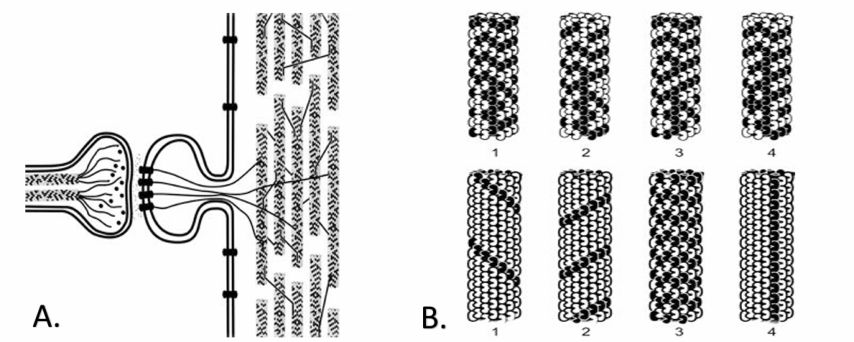
Figure 1. Information at microtubule level in neurons and Orch OR theory: A. An axon forms a synapse with a dendritic spine on a dendrite of another neuron; internal microtubules, actin, and membrane proteins are shown. Dendritic microtubules are interrupted, and in mixed polarity arrays. B. Top: 4 steps in a microtubule automata processing information with binary states of tubulins (Rasmussen et al., 1990). B. Bottom: Pathways through contiguous tubulin Fibonacci topological qubit pathways on microtubule A-lattice.
Coherent oscillations in and among microtubules inside neurons in kilohertz, megahertz, gigahertz, and terahertz (Saxena et al., 2020) should be able to host sequences of orchestrated quantum state ‘objective’ reductions (Hameroff and Penrose, 1996a; 2014a). In this framework, quantum superposition states evolve according to the
Schrödinger equation until reaching an objective threshold at which time t the quantum state reduces (‘collapses’) to a definite outcome. This occurs at times t = ℏ/EG where ℏ is the Planck-Dirac constant and EG the gravitational self-energy of the superposition ‘separating from itself’ (Penrose, 1989; 1994). Each such objective reduction (OR) event corresponds to a discrete moment of conscious experience, and the succession of these events generates the subjective flow of time. The temporal structure of conscious experience thus reflects the underlying quantum–classical sequence of OR events, linking picosecond to nanosecond to microsecond to millisecond dynamics of microtubule oscillations to the phenomenological sense of temporal continuity. Time is somehow intrinsic to both life and consciousness.
A time crystal is a phase of matter that breaks time-translation symmetry, exhibiting periodic dynamics even in its lowest-energy state (Wilczek, 2012). While originally conceived in ultra-cold quantum systems, the concept has been extended to driven, non-equilibrium systems (‘Floquet time crystals’) that maintain oscillations at subharmonic frequencies of an external drive (Else, Bauer and Nayak, 2016). Microtubules appear to function as polyatomic time crystals, in which their oscillatory hierarchy arises from multiple distinct subsystems, including C-terminal tail dynamics, lattice phonons, ordered water within the hollow core, and aromatic amino acid ring excitations, each contributing at characteristic frequencies (Sahu et al., 2013a; Saxena et al., 2020; 2022a).
Within this framework, microtubules, through their nested and scale-invariant oscillatory structure, are proposed as candidate biological timekeepers that couple molecular dynamics and orchestrated quantum state ‘objective’ reductions to subjective streams of consciousness in organic, quantum-friendly regions of warm biology. In this view, microtubules regulate cells structurally and dynamically as fractal time crystals and are also the quantum–classical interface through which orchestrated objective reductions give rise to conscious experience.
2. What is Consciousness?
Despite significant advances in neuroscience, the physical mechanism by which subjective conscious experience arises in the brain remains unresolved. Scientific approaches can be broadly grouped into two categories: neurocomputational models and fundamental-physics models.
‘Neurocomputational’ theories interpret the brain as a network of fundamental neurons that process information through classical electrical and chemical signalling. In these models, consciousness is proposed to emerge through complex computation among simple neurons, large-scale information integration, or recurrent signalling loops. Examples include the global neuronal workspace (GNW) theory (Dehaene and Changeux, 2011), integrated information theory (IIT, Tononi, 2004; Tononi et al., 2016), higher-order theories (HOT, Lau and Rosenthal, 2011), and predictive coding or recurrent processing (PC/RP) frameworks (Friston, 2010; Lamme, 2006). In all of these, the fundamental units of information are classical membrane events, such as action potentials and synaptic transmissions, operating predominantly in the hertz frequency range. These approaches have been useful in modelling certain cognitive functions but generally lack experimentally validated mechanisms that explain the qualitative features of conscious experience, or qualia (Nagel, 1974).
An alternative set of views holds that consciousness, or its basic experiential components, is a fundamental feature of reality, for example entailing quantum physics which describes the bizarre behaviours of particles at tiny scales. Quantum particles can unify coherently into one entity, be non-locally entangled, and exist in ‘superposition’ of multiple possible states simultaneously. Coherence and entanglement can provide living systems with properties of unitary oneness, a ‘self’, rather than an assembly of components (Hameroff, 1994). Superpositioned states are used in quantum computers as information, ‘quantum bits’, or ‘qubits’, e.g. both 1 AND 0 which appear to continue until ‘measured’ or consciously observed. It appeared to early quantum researchers like John von Neumann and Eugene Wigner, and more recently Henry Stapp, David Chalmers, and Kelvin McQueen and others, that ‘consciousness collapses the wave function’, to reduce, collapse, to definite states. Others suggest there is no collapse, that each possibility evolves in its own universe — a view called the ‘many worlds’ hypothesis (Everett, 1957). Still others consider an objective threshold, independent of conscious observers, at which quantum state reduction — collapse of the wave function — occurs (called objective reduction, or ‘OR’).
Among these is an OR proposal by Sir Roger Penrose (1989; 1994). It begins by equating quantum superposition to separated, alternate curvatures in space-time geometry, as described in Einstein’s (1916) general relativity (using 2-dimensional space-time sheets to illustrate, Figure 2). Separations would be at the Planck length of 10⁻³³ cm but extending significant lengths in other axes. Were such separations to continue, one might imagine, ‘many worlds’ would result, as proposed by Everett (1957). But space-time separations are unstable according to Penrose, and spontaneously reduce/collapse to single curvatures due to an objective threshold at time t = ħ/EG (ħ is the Planck-Dirac constant, and EG the gravitational self-energy of space-time separation). Each such OR event — a self-collapse of the quantum wave function occurring naturally in space-time geometry — is accompanied by a ‘NOW’ moment of (proto-)conscious experience, or ‘qualia’ (Figure 2). So rather than consciousness causing collapse, Penrose proposed collapse occurs spontaneously, and causes, or is equivalent to, a moment of consciousness. Moreover, each OR event is an ‘irreversible’ step forward in time, and thus OR may provide the ‘arrow of time’.
Why would OR events be conscious? Penrose (1989) argued, using Gödel’s incompleteness theorem, that human understanding requires a physical process that is neither algorithmic nor random. He proposed that objective reductions of quantum states meet this requirement, selecting outcomes in ways potentially influenced by Platonic values inherent in space-time geometry. On this view, OR events are accompanied by moments of conscious experience, with qualia taken to be fundamental features of space-time geometry itself (Hameroff and Penrose, 1996b). Penrose OR connects consciousness to the fine scale dynamics of the universe and remains the only scientifically specific proposal for experiential mental states.
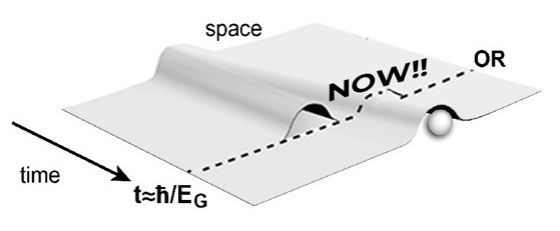
Figure 2. 4-dimensional space-time is portrayed as a 2D sheet, one dimension of space and one of time. A quantum particle is equivalent to tiny space-time curvature moving in time according to general relativity. The particle in a ‘superposition’ of two locations would be separated curvatures which continue until reaching threshold at time t. At that instant, separated space-time reduces to one (OR), one curvature is selected and the other ceases to exist, and a moment of proto-conscious experience (‘NOW’) occurs.
Experiential OR events in the random micro-environment would have random qualia, be disconnected and evanescent, and thus merely ‘proto-conscious’, metaphorically like sounds from individual musicians tuning their instruments before a performance. How could proto-conscious noise be ‘orchestrated’ into a conscious symphony in space-time geometry?
Structures in the brain were needed which could 1) ‘orchestrate’ (‘Orch’) quantum superpositions leading to sequences of ‘Orch OR’ events, 2) act as qubits in quantum computation halted/terminated by Penrose OR, and 3) regulate neuronal and synaptic functions anywhere in the brain. Microtubules were logical candidates.
But sceptics claimed the brain was too ‘warm, wet, and noisy’. Functional quantum mechanisms in laboratory settings require ultra-cold temperatures to avoid thermal ‘decoherence’. Nonetheless biological examples of functional quantum processes are now well established, including excitonic coherence in photosynthesis (Engel et al., 2007), radical-pair mechanisms in avian magnetoreception (Ritz et al., 2000), quantum tunnelling in olfaction (Turin, 1996), and temperature-independent conductance in microtubules (Sahu et al., 2014). Quantum spin transfer through organic aromatic rings increases with higher temperatures (Ouyang and Awschalom, 2003).
How is this possible? Cells are 70% water, but the remaining 30% includes solid structures including cytoskeletal microtubules, polymers of the protein tubulin. Within each tubulin, regions of non-polar ‘aromatic’ hydrocarbon rings of amino acids tryptophan, phenylalanine, and tyrosine coalesce in oil-like, water-excluding ‘hydrophobic pockets’. The basis for organic chemistry, the rings coalesce by quantum van der Waals forces, oscillate in terahertz, and are precisely where anaesthetics bind and act to selectively block consciousness (Figure 3, see Section 3).
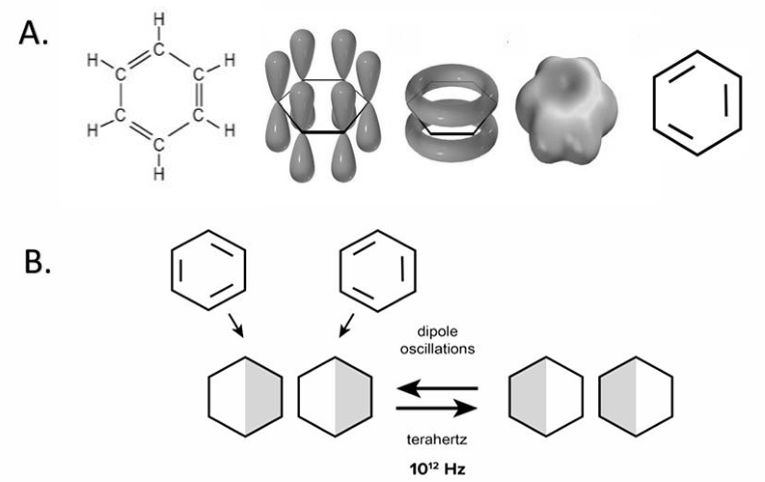
Figure 3. A. Organic ‘aromatic rings’ include hexagonal hydrocarbons with three extra electrons which delocalize into extended clouds above and below the rings. B. Such rings are often drawn as hexagons with three extra lines alternating positions, and attract as electronegativity induces dipoles (solid grey) which then couple and oscillate in terahertz.
There are 86 aromatic rings in each tubulin which can couple and oscillate along with those in neighbouring tubulins in helical lattice pathways (Figure 4). Thus quantum-friendly regions can extend mesoscopically within the many microtubules in all living cells, a pervasive ‘quantum underground’ (Figure 4, Craddock, Hameroff and Tuszynski, 2016).
Collective quantum oscillations among periodically-arrayed aromatic regions pumped by ambient heat were proposed to mediate ‘Fröhlich coherence’ (Fröhlich, 1968; 1970; 1975). Hameroff and Watt (1982) and Rasmussen et al. (1990) used Fröhlich coherence in megahertz and gigahertz as a ‘clocking mechanism’ for microtubule automata computation. Essential features of Fröhlich coherence were experimentally proven in microtubules by Anirban Bandyopadhyay’s group (Figure 5, Sahu et al., 2013a,b; 2014; Saxena et al., 2020; 2022a; Singh et al., 2021). They found self-similar resonance and excitation patterns (‘triplets-of-triplets’) repeating in hertz, kilohertz, megahertz, gigahertz, and terahertz frequencies in microtubules. This revealed microtubule fractal time crystal properties.
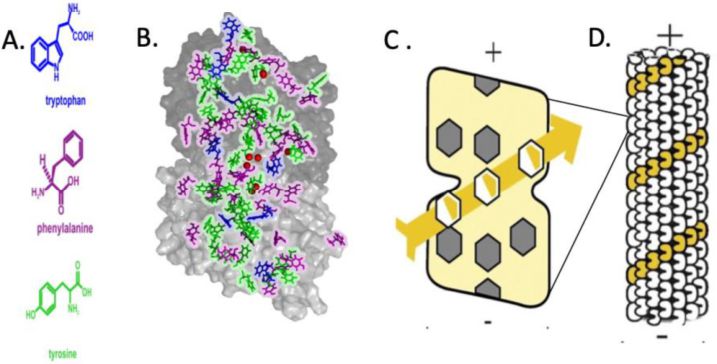
Figure 4. A. Aromatic amino acid rings in tryptophan, phenylalanine, and tyrosine. B. Tubulin with 86 aromatic amino acid rings, and anaesthetic binding (red spheres). C. Schematic of tubulin with only a few aromatic rings shown along several possible pathways through microtubule lattice, one being shown. D. Microtubule with helical qubit pathway determined in A–C.
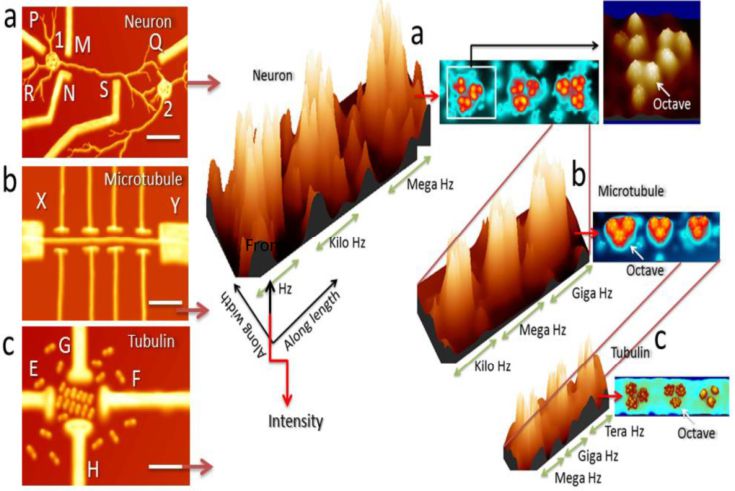
Figure 5. Experiments at three different scales by Bandyopadhyay’s group over years are shown. A. Pair of neurons 1 and 2 with 6 nanoprobes (M,N,P,Q,R), B. Single microtubule with 10 nanoprobes, and C. Two rows of tubulins with four nanoprobes. In all three scales, alternating currents were applied, sweeping frequencies from hertz to terahertz, measuring conductance. The neurons, microtubule, and tubulins were all insulators except for specific frequencies at which ballistic conductance was observed repeating in three peaks, each of those with three peaks, every three orders of frequency (triplets-of-triplets, ‘octaves’) in hertz, kilohertz, megahertz, gigahertz, and terahertz (Sahu et al., 2013a,b; 2014; Saxena et al., 2020; 2022a; Singh et al., 2021). With permission from Bandyopadhyay and NIMS, Tsukuba, Japan.
Bandyopadhyay’s discoveries supported orchestrated objective reduction (‘Orch OR’, Penrose and Hameroff, 1995; Hameroff and Penrose, 1996a,b; 2014a,b), a ‘fundamental’ approach to consciousness set in brain biology far more detailed than ‘neurocomputational’ theories. It suggests quantum superpositions in tubulin helical aromatic pathways act as topological qubits in neuronal microtubules (Figure 6). These evolve toward the Orch OR threshold and self-collapse, the resulting events corresponding to conscious moments and volitional selections. In this view quantum states are ‘orchestrated’ in microtubules through coherence, resonance, entanglement, and interference across many neurons, especially cortical pyramidal cell bodies and dendrites. The ensuing Orch OR events rhythmically alternate with classical input and output phases of neuronal signalling in kilohertz, megahertz, gigahertz, and terahertz frequencies, perhaps even faster and more non-local on occasion, accounting for various ‘psi’ effects.
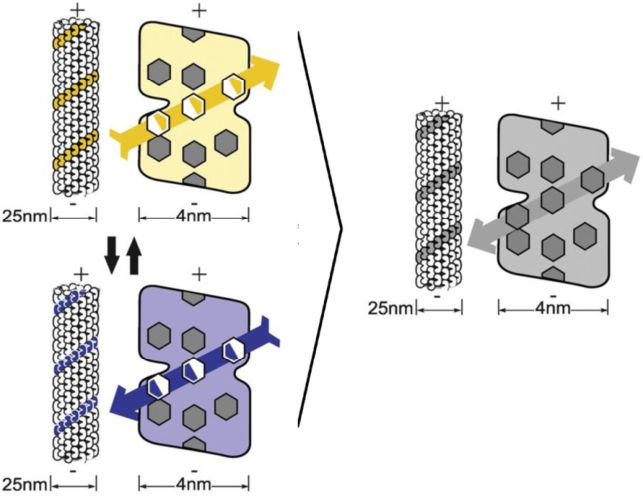
Figure 6. The Orch OR qubit. Dipoles extend along the ‘5-start’ helical path length of microtubule, can act as topological qubit in Orch OR. Left, two possible dipole orientations. Right: Superposition of both possible orientations.
However, cognition and consciousness in time frames for visual scenes and evoked potentials are in tens to hundreds of milliseconds, i.e. hertz, and brain activities need to ‘slow down’. This is likely enabled through interference beats among faster activities (as occur between musical instruments at slightly different frequencies). This can occur among mixed polarity, anti-parallel microtubules in dendrites and soma of layer 5 cortical pyramidal neurons to establish a fractal polyatomic time crystal hierarchy (Saxena et al., 2020; 2022a; Hameroff and Penrose, 2014a), a temporal framework for life and the sequencing of conscious moments.
3. Anaesthesia Selectively Blocks Consciousness
via Quantum Interactions with Microtubules
General anaesthetic gases are selective, blocking consciousness while sparing non-conscious brain processes, and may be the best way to find consciousness. But they have two paradoxical aspects: 1) despite their common action, anaesthetic gases vary widely in chemical and molecular structure, including halogenated hydrocarbons, ethers, and the inert gas xenon (Figure 7). However, they share one feature: major surfaces with filled electron orbitals, clouds of delocalized electrons which are non-polar, water-excluding, and chemically inert. Accordingly, 2) anaesthetics are chemically inert and bind by weak, quantum van der Waals interactions non-specifically and ‘promiscuously’ to a host of different molecules in large amounts. How does widespread non-specific binding lead to selective, specific anaesthetic effects only on consciousness?
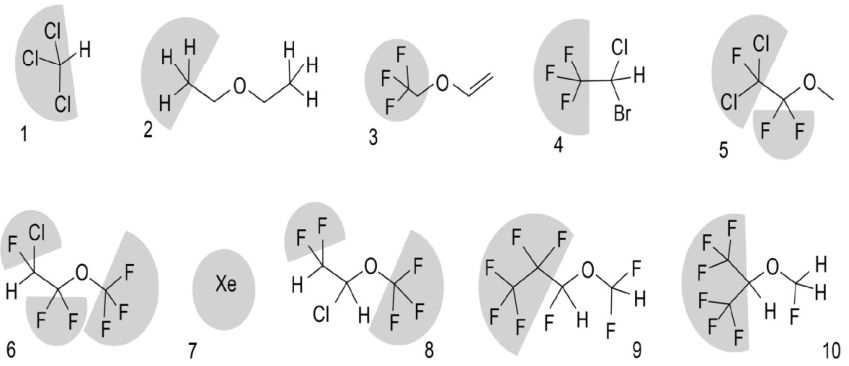
Figure 7. Ten anaesthetic gases which follow the 'Meyer-Overton correlation' are structurally diverse and chemically inert, but share a common feature of non-polar, filled electron outer shell orbitals (grey). The anaesthetic gases are 1. chloroform, 2. diethyl ether, 3. fluoroxene, 4. halothane, 5. methoxyflurane, 6. enflurane, 7. xenon, 8. isoflurane, 9. desflurane, 10. sevoflurane.
In the nineteenth century, gases were discovered which caused giddiness and euphoria when inhaled at low concentrations, e.g. ‘ether frolics’ and ‘laughing gas’. But at higher concentrations they caused caused loss of responsiveness, purposeful behaviour, and consciousness, and became used in surgery.
At the turn of the twentieth century, Hans Meyer (1897) and Charles Overton (1901) determined anaesthetic potency for each gas in causing animals and humans to become unresponsive and immobile. They measured the anaesthetic gas concentration in the animals’ lung alveolae (at equilibrium) required to block 50% of subjects from moving when stimulated (this became known as the ‘minimal alveolar concentration’, ‘MAC’). They found that potency at equilibrium varied among anaesthetics, but for salamanders, worms, mammals, and humans the potency for each anaesthetic was essentially the same. They also found MAC was additive, so a ‘half MAC’ of one anaesthetic and a ‘half MAC’ of another were equivalent to one MAC of either. These findings led to a ‘unitary hypothesis’ that all anaesthetics acted on the same molecular target in the brain, and implied that all animals and humans have the same mechanism for consciousness. What was it?
Drug molecules bind and act in regions of their greatest solubility. Most drugs are polar, charged, soluble in liquids, and bind and act on charged receptors on membrane-liquid surfaces. On the other hand, anaesthetic gases are non-polar, uncharged, and chemically inert. Poorly soluble in fluids, they pass quickly through the blood to non-polar, fat-like or ‘oil-like’ media where they dissolve (‘oil and water don’t mix’). Meyer and Overton compared solubility of the gases in many with potency (‘1/MAC’) in rendering animals and humans unresponsive. They found a remarkable correlation over several orders of magnitude between anaesthetic potency and solubility in a non-polar, lipid-like medium akin to olive oil and aromatic rings (15.1 ‘Hildebrand solubility units’).
Such solubility is found in membrane lipids, nucleic acids, and protein interiors (with aromatic amino acid rings) all over the brain and body. Franks and Lieb (1984) showed direct anaesthetic effects on a protein proportional to Meyer-Overton solubility, and membrane protein receptor and ion channels became prime suspects for the ‘site of action’. Anaesthetics do indeed bind to receptors for GABAA, serotonin, NMDA, and other receptor and ion channel proteins, but their effects were inconsistent. Some anaesthetics open a particular ion channel, and others close it. Not all anaesthetics bind to any one membrane receptor, excluding a unitary mechanism. Decades of research on neuronal membrane proteins failed to find targets suitable for explaining anaesthetic action. Leading experts concluded that ‘no single membrane protein, or group of membrane proteins could account for anesthetic action’, and a ‘new paradigm’ was called for (Eger et al., 2008).
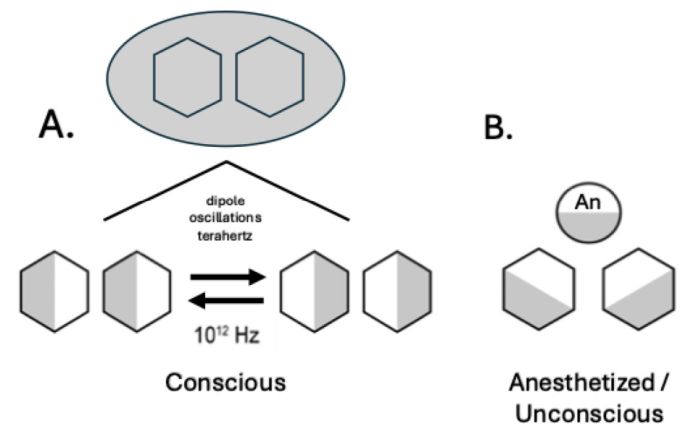
Figure 8. A. Two dipole-coupled rings oscillate in terahertz, and form superposition (above), a ‘quantum bit’ or ‘qubit’ able to support consciousness in Orch OR. B. Anaesthetic (An) binds by van der Waals ‘dipole dispersion’ forces, dampening and randomizing oscillation, preventing superposition and consciousness.
The ‘new’ paradigm should have been microtubules. In 1846 Claude Bernard showed cytoskeletal-dependent movement of amoeba slime mould was halted by exposure to the anaesthetic gas chloroform, and movement resumed when the chloroform was removed (in modern times amoeboid movement in slime mould has been shown to solve complex problems, e.g. Adamatzky and Jones, 2014).
Allison and Nunn (1968) studied tiny urchins called actinosphaerum which have many protruding axonemes — needle-like extensions composed of membrane-covered arrays of microtubules. Upon exposure to the anaesthetic gas halothane, the microtubules disassembled and the axonemes disappeared. The authors suggested anaesthetic-induced loss of consciousness was due to reversible depolymerization of brain microtubules. However, the depolymerization in actinosphaerum was due to halothane concentrations of 5 MAC, and clinical levels would not necessarily cause disassembly. Alzheimer’s disease is marked and perhaps caused by disassembly of microtubules in brain neurons (Matsuyama and Jarvik, 1989).
In systematic experiments, radiolabelled halothane anaesthetic was found to bind 70 different proteins in mouse brain neurons, half in membrane and half in cytoplasm including tubulin (Pan et al., 2007). Studies of gene expression following anaesthesia suggested a functional role for tubulin in action of anaesthetics (Fütterer et al., 2004; Xi et al., 2004; Kalenka et al., 2007). Emerson et al. (2013) prepared an anthrocene derivative which was only anaesthetic when it fluoresced by ultraviolet light and gave it to tadpoles who have conveniently transparent heads. After swimming freely, the tadpoles were illuminated with ultraviolet light which caused fluorescence, and the tadpoles ceased movement. Upon post-mortem examination the anthrocene anaesthetic molecules were bound to tadpole brain microtubules.
The anti-cancer drug paclitaxel (‘Taxol’) binds and stabilizes microtubules. Patients who came for surgery while taking paclitaxel required significantly more anaesthetic (propofol) than non-paclitaxel patients (Linganna et al., 2015). In a randomized trial, Khan et al. (2024) measured time to loss of righting reflex in mice breathing 4% isoflurane. Mice given the microtubule-stabilizer drug epothilone B had significantly delayed onset of anaesthetic-induced loss of consciousness.
As part of the Templeton programme ‘Accelerating Research on Consciousness’, Orch OR was tested based on two predictions (Hameroff, 2021). 1) A potentially functional quantum effect would be demonstrated in microtubules at ambient temperature which would 2) be inhibited by anaesthetics. Tryptophan fluorescence lifetimes were studied in microtubules. Upon ultraviolet excitation, quanta of electron energy (excitons) propagated through the microtubule farther and for longer duration than predicted by classical mechanisms, indicating a quantum effect at ambient temperature. The presence of two different anaesthetics, isoflurane and etomidate, significantly inhibited quantum exciton propagation time and distance (Kalra et al., 2023). Genomics, proteomics, optogenetics, pharmacodynamics, and quantum optics all point to tubulin/microtubules as the target of anaesthetic action, and site of consciousness.
What do anaesthetics do at their apparent microtubule site of action? Craddock et al. (2017) computer modelled quantum van der Waals dipole couplings among the 86 aromatic amino acid rings in tubulin, revealing an emission spectrum with a common mode peak at 613 terahertz (blue-green light, 489 nm). When each of eight different anaesthetic molecules were introduced, terahertz oscillations were dampened and the peak shifted to lower frequencies, with the magnitude of the shift proportional to anaesthetic potency (1/MAC). This computer modelling result reveals the Meyer-Overton correlation in dampening quantum mechanisms in microtubules.
How do anaesthetics bind indiscriminately in large amounts all over the brain and body to a myriad of molecules, and yet selectively block only consciousness with little or no effects on any other physiological processes? Collective, highly organized/orchestrated quantum processes, e.g. in microtubule time crystals, are easily randomized by anaesthetic ‘dipole dispersion’ couplings. Other anaesthetic quantum interactions in the brain and body are with processes already randomized, and thus unaffected.
4. Time Crystals in Physics and Technology
In condensed matter physics, a crystal is a spatially periodic lattice that breaks continuous spatial-translation symmetry. In 2012, Wilczek proposed an analogous ‘time crystal’ in which a system’s dynamics exhibits periodic structure in time, breaking continuous time-translation symmetry (Wilczek, 2012). Shapere and Wilczek (2012) formulated models of classical time crystals, in which a macroscopic system displays perpetual periodic motion in its lowest-energy configuration under classical mechanics, while Wilczek outlined the quantum case, in which temporal periodicity would occur in the ground state of a quantum system (Wilczek, 2012).
Persistent motion in a true equilibrium ground state is incompatible with thermodynamics, motivating a reformulation in terms of driven, non-equilibrium systems. These discrete or Floquet time crystals are periodically driven and respond at a subharmonic of the driving period, maintaining phase coherence over extended times despite perturbations (Else, Bauer and Nayak, 2016). Experimental realizations have since been reported in ultra-cold and solid-state platforms.
Zhang et al. (2017) used a chain of ten ultra-cold ytterbium ions, with nuclear and electron spins interacting as qubits. Excitation with a dual-laser sequence induced stable, repetitive spin oscillations resistant to perturbation, thereby realizing a time-crystalline phase.
Kongkhambut et al. (2022) reported a continuous time crystal using a Bose-Einstein condensate inside an optical cavity continuously pumped. A time-crystal system with fractal dynamics was reported by Giachetti et al. (2023) in ultra-cold conditions. And a further major advance was achieved by Greilich et al. (2024) who excited indium gallium arsenide doped with silicon and observed collective nuclear– electron spin oscillations with a characteristic ‘M-shaped’ temporal profile with a six-second period, much slower than the excitation frequency. The oscillations persisted for forty minutes until deliberately terminated.
Time crystalline order protected by topology has also been engineered on superconducting qubit arrays (Xiang et al., 2024), and photonic platforms have demonstrated tunable time-crystal concepts for ‘timetronics’ and temporal information processing (Zheludev, 2024). Ippoliti et al. (2021) programmed a time crystal on a Sycamore quantum computer. Zhao and Smalyukh (2025) developed a spacetime crystal in a nematic liquid crystal producing visible dynamic stripe patterns by topological solitons. Finally, time crystal behaviour occurs as spontaneous dissipation in two-dimensional lattices of neutral atoms in ‘Rydberg states’, collective electron excitatory quantum states (Russo and Pohl, 2025). Rather than external driving, this time crystal behaviour is driven by intrinsic ‘internal’ quantum fluctuations.
These time crystals consist of interactions among identical components. Biological structures including microtubules are warm, composed of various types of atoms, and seem to repeat dynamics at logarithmic periodicity in frequency, and organize space as well as time.
5. Could Biological Microtubules Be Polyatomic Fractal Time Crystals?
5.1. Microtubule information processing
Microtubules are self-assembling polymers of peanut-shaped proteins called tubulin which form cylindrical hexagonal lattices. Part of the cytoskeleton which spatially and dynamically organizes intra-cellular activities, microtubules are found in all eukaryotic and archaea cells (Wollweber et al., 2025). Tubulin is the most abundant protein in the brain, so more than any other structure the brain is made of microtubules.
Tubulins are peanut-shaped dimers with positive and negative ends so each tubulin, linear chain (protofilament), and microtubule has net polarities. In neurons and other cells, thirteen protofilaments associate laterally to form a hollow cylinder with an outer diameter of ~25 nm and an inner lumen of ~14 nm, and hexagonal tubulin lattices in the curved cylinder wall. The A-lattice has Fibonacci geometry (see below), and naturally occurring oscillations over multiple frequencies conceptualized by Fröhlich coherence in the 1970s and experimentally verified in microtubules by Bandyopadhyay and colleagues (Sahu et al., 2013a,b; 2014; Saxena et al., 2020; 2022a; Singh et al., 2021). Among other uses, coherent oscillations can organize and update computational cycles.
Do microtubules and the cytoskeleton perform cognitive functions? Peters, Palay and Webster (1976) noted the strategic localization of microtubules and associated proteins within dendrites and axons, suggesting potential involvement in transport and signalling. In parallel, Fröhlich (1968) proposed that biological lattice structures could exhibit coherent excitations if supplied with metabolic energy, predicting collective vibrational modes, e.g. in the microwave (gigahertz) or radiowave (megahertz) range.
Rasmussen et al. (1990) formalized microtubule automata based on dipole couplings among tubulins updating or clocking interactions based on Fröhlich coherence in skewed hexagonal A-lattices. Recursive networks showed self-learning, and they estimated information processing at the microtubule level to be ~1 billion tubulins/neuron oscillating at 10 megahertz as 10¹⁶ operations per second per neuron. This contradicted robotics and AI estimates of brain capacity based solely on neuronal membrane and synaptic signalling to be 10¹⁶ operations per second for the entire brain (e.g. Moravec, 1988; Kurzweil, 2000). Coherent oscillations in microtubules related to biological regulation may be an essential feature of life.
5.2. Fibonacci geometry and the ‘quantum underground’
In the microtubule A-lattice Fibonacci geometry, skewed hexagonal configurations create seamless helical pathways around the 13 protofilament cylinder, and vertically along protofilaments. These windings repeat at Fibonacci numbers 3, 5, and 8 along contiguous tubulin dimers (or monomers for the 3-winding, Figure 3B). Such aperiodic order minimizes lattice defects, optimizes mechanical stability, enhances coherence length for vibrational and electronic modes by distributing structural strain uniformly, and could confer qubit stability and topological quantum error correction. Attempts to implement qubits in oscillating quantum systems have led to topological pathways with periodic displacements in 2D surface codes, e.g. the Gottesman-Kitaev-Preskill topological quantum error correction codes (Grimsmo and Puri, 2021). Intersections of helical pathways on a cylindrical microtubule lattice have been proposed to mediate Aharonov-Bohm superpositions (Hameroff and Penrose, 2014a).
These pathways can mediate both mechanical and electromagnetic energy transfer classically over mesoscopic scales, and may serve as topological qubits for quantum dipole and spin coupling, and entanglement reaching biological scales. Delocalized π-electrons of the 86 aromatic rings in each tubulin can participate in resonant dipole–dipole couplings (Förster-type) or quantum van der Waals/London interactions, and in some cases spin-exchange coupling. Quantum electron spin transfers through aromatic rings are enhanced by increased temperature (Ouyang and Awschalom, 2003).
Within individual tubulins, aromatic rings form non-polar ‘hydrophobic pockets’ with reduced dielectric constant, excluding bulk water and providing a decoherence-protected ‘quantum-friendly’ environment (Sahu et al., 2013a). The rings are close enough to rings in all six neighbour tubulins for inter-tubulin π–π coupling, and thus aromatic quantum regions defined by Hildebrandt solubility 15.1 may extend lengths of microtubules along Fibonacci helical pathways, hosting quantum mechanisms throughout all living cells, dubbed the ‘quantum underground’ (Craddock, Hameroff and Tuszynski, 2016). This quantum-friendly region is precisely where anaesthetics bind by quantum interactions to selectively block consciousness. Recent experiments confirm photon-induced electronic energy migration beyond classical limits along microtubules in vitro, with coherencesensitive inhibition by clinical anaesthetics (Kalra et al., 2023).
5.3. Multiple oscillatory subsystems in microtubules
In the 1960s and 1970s, Arthur Winfree at the University of Arizona found similar mathematics at different timescales produced similar functional patterns governing cardiac arrythmias, circadian rhythms, self-organization of slime moulds, and growth of lichen, describing them as ‘clocks within clocks’ (Winfree, 1980). Herbert Fröhlich (1975) theorized biological lattices of non-polar regions would oscillate coherently in gigahertz and megahertz from ambient thermal energy in biological systems.
Beginning around 2010, using nanotechnology and electromagnetic resonance techniques, Bandyopadhyay and his team at NIMS in Japan demonstrated that microtubules and related cytoskeletal structures exhibit self-similar oscillatory dynamics across 12 orders of frequency, from hertz to terahertz. These nested resonances manifest as repeating ‘triplet-of-triplet’ and ‘pentuplet’ patterns at the levels of tubulin dimers, microtubules, neurons, and brain networks (Figure 4). These signatures are measurable not only within cells but also non-invasively from the human scalp where recordings in humans reveal a nested twelve-level hierarchy, termed the ‘dodecanogram’, linking macroscopic brain rhythms to underlying fast cytoskeletal oscillations (Singh et al., 2023; Dutta and Bandyopadhyay, 2024).
Multiple experimental approaches demonstrate that microtubules exhibit self-similar resonance patterns spanning at least twelve orders of magnitude in frequency. Dielectric resonance spectroscopy of single-tubulin proteins reveals a distinctive triplet-of-triplet structure in the megahertz range, with each main resonance peak subdivided into three equally spaced sub-peaks (Saxena et al., 2020). This triplet-of-triplet motif is preserved in isolated microtubules, microtubule bundles, cultured neurons, and brain tissue slices, and megahertz triplets can be detected non-invasively in intact human scalp recordings (Singh et al., 2023). Additional pentuplet structures indicate the presence of further oscillatory subsystems embedded within the polyatomic hierarchy (Saxena et al., 2022b). The logarithmic spacing of these sub-peaks across all scales of observation, from within nanometer-sized proteins to macroscopic brain activity, demonstrates fractal self-similarity.
How do living systems organize across scale? In the brain there are activities related to cognitive processes from very fast to very slow, from small to large across the brain. The resonant frequencies for triplets in microtubule time crystal behaviour appears to require specific subsystems within microtubules. Figure 9 shows three of these: CT indicates C-termini tubulin tails with negative charges which extend, couple, and oscillate collectively with nearby tails, water, and ions in kilohertz triplets-of-triplets. The microtubule (MT) oscillates in megahertz by phonons, dipole couplings, and polaritons, and the ordered water (WT) in the hollow microtubule core oscillates in gigahertz. Terahertz, hertz, and slower circadian rhythms are described below.
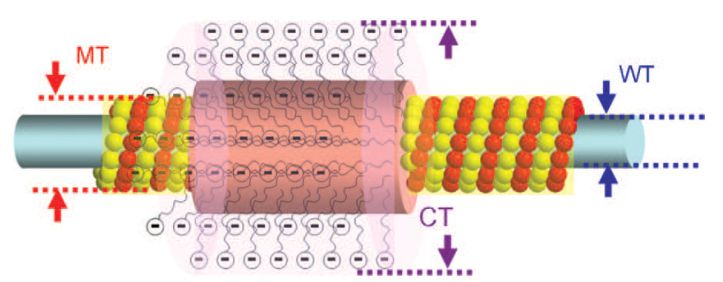
Figure 9. Three oscillating subsystems in a microtubule. CT: negatively-charged C-termini ‘tails’ on each tubulin interact with water and ions, oscillate in kilohertz. MT: microtubule components tubulin oscillate in megahertz (phonons/dipoles/polaritons). WT: ordered water channel in hollow microtubule core oscillates in gigahertz. See Appendix. With permission from Bandyopadhyay and NIMS, Tsukuba, Japan.
Biological time crystal behaviour in microtubules may span 21 orders of frequency magnitude, from petahertz (10¹⁵ Hz) to daily circadian rhythms (10⁻⁶ Hz) (see Figure 12 further below).
- Petahertz: Ultraweak photon emission, near-infrared to ultraviolet photons, possibly from aromatic ring π-electron dipole oscillations, e.g. 750 nm wavelength to 300 nm, possibly driven by mitochondrial photons (Popp, 1986; van Wijk et al., 2020; Salari et al., 2015; Casey et al., 2025).
- Terahertz: Aromatic π-electron transitions — the ultrafast oscillations of π-electrons in aromatic amino acids produce terahertz-range transitions. Some of these transitions couple to optical modes, generating measurable photon emission, such as a characteristic 613 THz (489 nm) blue-green signal (Craddock et al., 2017), fluorescence (Kalra et al., 2023), and superradiance (Babcock et al., 2024; cf. Kurian, Obisesan and Craddock, 2017; Saxena et al., 2020; Zhang et al., 2017).
- Gigahertz: Tubulin protein dynamics, ‘ordered water’ modes — the lumen contains structured water organized into concentric cylindrical layers. These layers form hydrogen-bond networks that support coherent gigahertz vibrational modes, likely coupled to lattice phonons (Sahu et al., 2013a,b; Singh et al., 2021).
- Megahertz: Beta sheets, lattice phonons, polaritons, collective acoustic and optical vibrational modes propagate longitudinally, helically, circumferentially (Sahu et al., 2013a; Singh et al., 2021). Orch OR at megahertz frequencies (Hameroff and Penrose, 2014a).
- Kilohertz: C-terminal tail oscillations, ionic conductance, structured water Brownian and electrostatic motion occurs in the kilohertz range, influencing ionic (Saxena et al., 2020).
- Hertz: Neuronal membrane activities including EEG rhythms are in hertz, and may be related to interference beats or direct oscillations in microtubules inside neurons, for example at 39 hertz (Gutierrez, Cantiello and Cantero, 2023).
- Sub-hertz: Circadian rhythms usually imply 24-hour cycles, and may be related to microtubule oscillations. Patients on antimicrotubule drugs for cancer treatment have disturbances of circadian rhythms. In a mouse study, the microtubule stabilizer drug paclitaxel (Taxol) caused disturbances in numerous measures of circadian rhythms (Sullivan et al., 2022; Tapp et al., 2025). Photon emission from the human body fluctuates with circadian rhythms (Kobayashi, Kikuchi and Okamura, 2009).
Figure 10 shows a microtubule B-lattice with some tubulin monomers removed to see the internal structure. Water molecules ordered on external (blue-green) surfaces oscillate coherently with tubulin C-termini and ions in kilohertz. Water ordered on microtubule hollow interior core (dark blue) oscillates in gigahertz (Figure 10C).
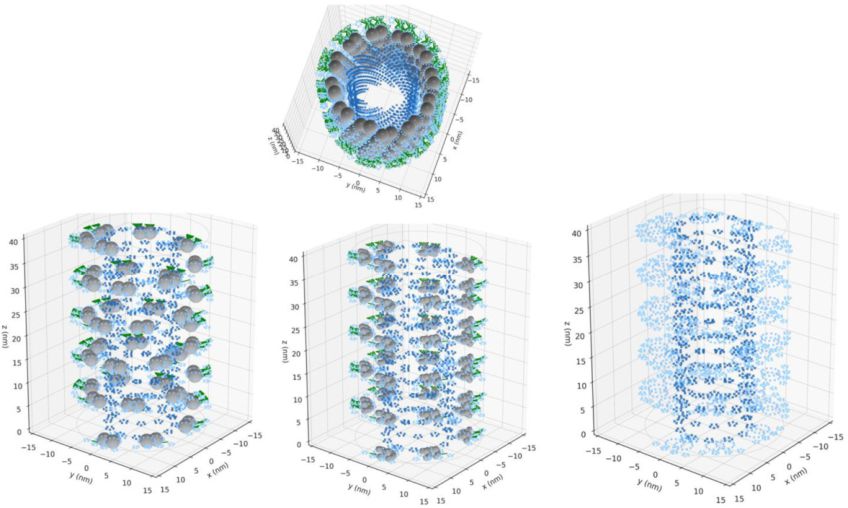
Figure 10. Molecular simulation of microtubule B-lattice with monomers removed to see ordered water molecules inside (dark blue, gigahertz oscillations) and outside (blue-green, kilohertz oscillations) microtubule cylinder. See Appendix.
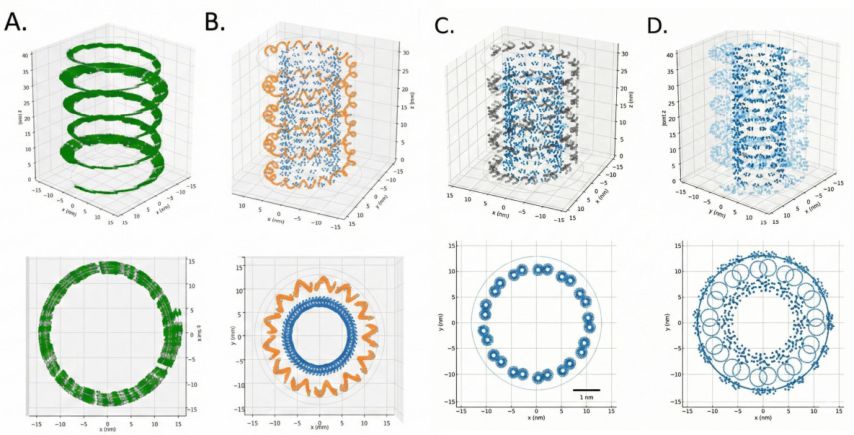
Figure 11. Vibrational subsystem modes of microtubules. A) C-termini and associated molecular ionic excitons vibrating at kilohertz frequencies with solitonic wave. B) Beta sheets inside tubulin, nested polaritons vibrate in MHz region. C) Eight different alpha-helical clusters of tubulins vibrate in GHz. D) Hierarchical architecture of only water channel vibrating in THz and near IR region. See Appendix.
Figure 11 shows vertical and top-down views of oscillating components in microtubule B-lattice for the different frequency ranges. A. Green denotes ordered water oscillating in kilohertz. B. Beta sheets host nested polaritons within tubulins oscillate in megahertz. C. Alpha helical clusters within tubulins oscillate in gigahertz. And D. Hierarchical water channel oscillates in terahertz. See Appendix.
These oscillatory subsystems cooperate such that lower-frequency modes (e.g. KHz C-terminal dynamics) can amplitude- or phasemodulate higher-frequency modes (e.g. MHz lattice phonons, GHz water modes), while higher-frequency oscillations can entrain, stabilize, and interfere to give slower rhythms. Bottom-up and top-down effects can occur in a nested oscillator hierarchy with fixed phase relationships across scales, producing a structure of ‘clocks within clocks’. This organization matches the definition of a polyatomic time crystal (Saxena et al., 2022a,b) in which multiple oscillatory subsystems with different intrinsic frequencies maintain stable, scale-invariant phase coupling.
The dodecanogram reveals a nested frequency hierarchy in the human brain that spans from hertz-range electroencephalographic rhythms, through kilohertz-range C-terminal tail dynamics, megahertz-range lattice and dipole oscillations, and gigahertz-range ordered water modes, to terahertz-range aromatic π-electron transitions (Singh et al., 2023). Fixed frequency ratios among peaks across this range confirm the scale-invariant nature of the resonance patterns, consistent with the definition of a fractal polyatomic time crystal.
Bandyopadhyay developed the concept of a scale-invariant hierarchy in a living system based on collective microtubule time crystal behaviour which would link consciousness to fundamental reality based on Penrose OR, and organize living systems. Figure 12 illustrates such a system based on microtubule time crystal behaviour.
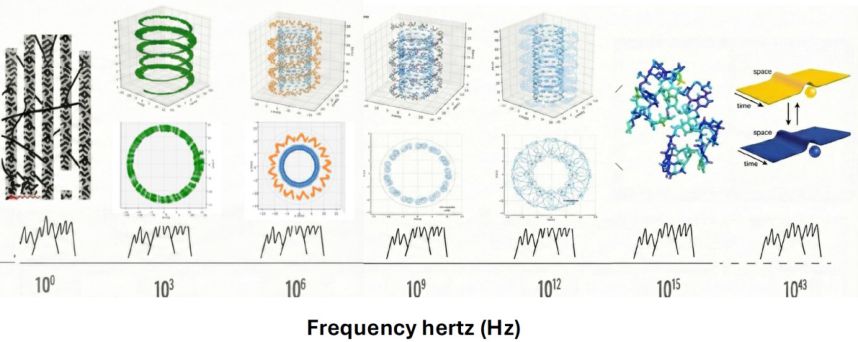
Figure 12. A scale-invariant spatio-temporal hierarchy based on microtubule time crystal behaviour in which Orch OR-mediated consciousness can occur. From left to right (slower Circadian rhythms not shown): 1) network of microtubules inside neuron, 100 hertz, EEG, 1 second, (hertz), 2) ordered water, C-termini, and ions on microtubule exterior, 10³ hertz (kilohertz), 3) beta sheets host phonons, polaritons, dipole oscillations, 10⁶ hertz (megahertz), 4) alpha helices, ordered water in hollow core, 10⁹ hertz (gigahertz), 5) ordered water in hollow core, aromatic ring photoexcitations, 10¹² hertz (terahertz), 6) polyaromatic hydrocarbon oscillating 10¹⁵ hertz (petahertz). Skipping 28 orders of magnitude, 7) Planck-scale oscillations proposed by Penrose OR, 10⁴³ hertz.
6. Biological Driving Mechanisms
In condensed matter physics, Floquet time crystals are periodically driven many-body systems that respond at subharmonic frequencies of the driving period (Else, Bauer and Nayak, 2016). The stability of these systems depends on maintaining a balance between the driving input and suppression of rapid thermalization. The essential requirements are a source of periodic modulation, an intrinsic oscillator network capable of coupling to the drive, and a mechanism for maintaining fixed phase relationships across oscillatory modes. Microtubules possess the latter two features by virtue of their polyatomic oscillator hierarchy, which maintains stable phase relationships from hertz to terahertz frequencies. Microtubule time crystals could be driven by intrinsic quantum fluctuations, e.g. as in the dissipative time crystal described by Russo and Pohl (2025), and biological Fröhlich coherence. But there are biologically plausible periodic drives for Floquet time crystal behaviour in microtubules.
Mitochondrial ultraweak photon emission (UPE) offers a credible candidate for photonic input to neuronal microtubules. UPE arises from oxidative metabolic reactions and reactive oxygen species (ROS) generation, producing broadband emission spanning ultraviolet (UV) through visible to near-infrared wavelengths (Cifra and Pospíšil, 2014; Van Wijk et al., 2020).
Importantly, this includes a UV component in the 200–400 nm range, attributed to electronically excited carbonyls and singlet oxygen produced during mitochondrial respiration (Kurian et al., 2017). These emissions overlap with the absorption spectra of aromatic tryptophan and tyrosine (~280 nm), abundant in tubulin dimers in π-electron networks capable of excitonic energy transfer. Experimental studies show that microtubules reorganize in a dosedependent manner under UV exposure, with the strongest effects around 280 nm, consistent with aromatic amino acid absorption (ibid.).
In addition to the UV band, mitochondrial UPE extends into the blue-green visible range (480–500 nm), corresponding to aromatic π– π* electron transitions in tubulin (~613 THz) (Kalra et al., 2023). These photons are of particular relevance since coherent excitonic transport in microtubule aromatic networks has been predicted and experimentally supported to occur over distances exceeding classical Förster limits (Craddock, 2025). Mitochondria are often co-localized with microtubules in axons, dendrites, and near synapses, suggesting a natural arrangement for photonic coupling between mitochondrial emission and tubulin absorption (Rahnama et al., 2011; Salari et al., 2015). Moreover, mitochondrial metabolism is modulated by respiratory rhythms and ATP demand cycles, producing pulsatile photonic output in the hertz to kilohertz range (Van Wijk et al., 2020), which could entrain oscillatory dynamics in the microtubule network. Casey et al. (2025) detected IR and visible wavelength (400 to 900 nm) photons emitted from human scalp buried in the EEG (‘photoencephalography’), correlating with cognitive functions.
Microtubules may act as biophotonic waveguides, channelling UPE along the cylindrical wall or through the lumen (Jibu et al., 1994). Periodic or quasi-periodic mitochondrial photon pulses could thus serve as an endogenous drive analogous to the laser or microwave fields used to generate Floquet time crystals in laboratory systems. Photons in the blue-green range would couple first to the terahertz aromatic oscillators, which in turn would transfer energy into gigahertz ordered water modes and megahertz lattice phonons. These faster oscillations would then modulate the kilohertz C-terminal tail motions and hertz-range network rhythms, preserving stable phase relationships across the entire hierarchy. In the brain, such downshifting may occur by negative resonance, i.e. interference beats to give rise to the electro-encephalogram (EEG).
Mitochondrial UPE may function as a biological Floquet driver that entrains the intrinsic polyatomic time crystal structure of microtubules. The cascading interactions from photonic input down through the oscillator hierarchy sustain the fractal resonance patterns observed experimentally. Disruption of this coupling, as by anaesthetic binding to aromatic hydrophobic pockets in tubulin, would block the multifrequency phase locking, time-crystal phase, and structured temporal framework required for conscious processing.
Other possible driving mechanisms could include megahertz and or gigahertz signals from other microtubules, e.g. in other cells or neurons (Singh et al., 2021). Phosphorylation of microtubules by the memory enzyme CaMKII could drive oscillations, as could a host of sensory or other signals. Local sensitivity with global reaction is a hallmark of living systems. The combination of experimentally verified scale-invariant resonance motifs, stable cross-frequency phase coupling, and the presence of biologically plausible periodic drives supports the interpretation of neuronal microtubules as driven polyatomic fractal time crystals.
7. Comments on ‘Superpsychism’ by Schneider and Bailey
Schneider and Bailey (S&B; this issue) offer a philosophical proposal in which quantum entanglement is treated as occurring in a non-spatio-temporal ‘prototemporal’ arena. On this view, the most fundamental level of nature forms an holistically entangled ‘megaobject’ with maximal coherence and minimal entropy, and consciousness is attributed to this putative structure. This interpretive framework sits alongside a broader family of ‘emergent space-time from entanglement’ approaches in quantum gravity, but it does not introduce new empirical claims about physical systems or testable predictions relevant to biological substrates.
7.1. Consciousness and entanglement outside space-time
S&B motivate superpsychism by suggesting that entanglement belongs to an underlying domain from which space-time emerges. This move echoes certain information-theoretic programmes in quantum gravity, but it is not required by known physics. In operational quantum mechanics, entanglement is fully compatible with standard four-dimensional space-time and does not violate relativistic causal structure. Instantaneous correlations do not imply superluminal influence, and the theory’s no-signalling constraints remain intact.
Our framework remains within standard space-time geometry. The microtubule time-crystal model does not rely on structures ‘outside’ space-time, but on experimentally accessible coherent dynamics embedded within biological matter.
7.2. Coherence, resonance, and the emergence of conscious moments
A central claim of S&B is that consciousness corresponds to ‘maximal coherence’ in a pre-spatio-temporal domain. This proposal treats coherence as ontological and experiential at the deepest level but offers no dynamical pathway from such coherence to the structured temporal sequence of conscious states.
Our approach focuses instead on how coherence and resonance manifest within matter. Microtubules exhibit nested, scale-invariant oscillatory structure from hertz to terahertz regimes, and these resonances interact with objective transitions between quantum and classical regimes. The result is a hierarchy of periodic, physically instantiated processes, captured by our microtubule time-crystal model, that can generate structured temporal experience without positing a separate ontological arena.
7.3. Resonance and integration
S&B appeal to general resonance theory (GRT) as a conceptual bridge between coherence and consciousness. In that framework, consciousness arises when oscillatory processes align to enable efficient information flow. Their discussion is restricted to macroscopic neural frequencies.
Our model extends resonance inward: microtubules form nested oscillator hierarchies capable of coherence and phase-locking at biological, molecular, and quantum scales. This provides a concrete physical substrate for the kind of integration S&B describe, without relying on metaphysical claims about maximal coherence outside space-time.
7.4. Relation to Chalmers
S&B cite Chalmers as motivating the need for physics beyond current models to account for consciousness, such philosophical considerations stemming from Schrödinger and Penrose. Our focus here is providing a physical, experimentally tractable account of coherent information dynamics in biological systems. These mechanisms can be probed empirically and do not require commitments about non-spatio-temporal consciousness.
7.5. Collapse vs. coherence
S&B emphasize pure-state coherence and regard decoherence as the step by which consciousness ‘enters’ space-time. Our model differs substantially. We examine how coherent microtubule dynamics interact with real quantum–classical transitions within matter and how these transitions can produce structured sequences of experiential events. Both approaches assign a functional role to coherence and resonance, but our account is grounded in specific biophysical structures rather than in ontological claims about the nature of reality.
7.6. Summary of S&B
S&B introduce a metaphysical interpretation that situates consciousness in a non-spatio-temporal, maximally coherent entanglement structure. While conceptually intriguing, this framework does not directly connect to empirical biology nor to the physics of time-crystalline order. Our model instead focuses on experimentally testable resonant dynamics within microtubules, showing how nested oscillations and quantum–classical transitions can generate temporally structured conscious processes. The two views share vocabulary (coherence, resonance, integration) but differ fundamentally in scope, method, and empirical grounding.
8. Conclusion
In condensed matter physics, a crystal is a solid whose constituents are arranged in a spatially periodic lattice, breaking continuous spatialtranslational symmetry. A ‘time crystal’ is a phase of matter in which the state of a system exhibits periodic dynamical structure in time, breaking continuous time translational symmetry. Time crystals are nested hierarchies, ‘clocks within clocks within clocks…’, patterns of oscillations repeating at multiple frequencies including a lowest energy quantum ground state.
Time crystals were proposed as theoretical possibilities by Nobel laureate Frank Wilczek (2012), after which they began to be implemented using various quantum technologies at ultra-low temperatures. But persistent motion in a true equilibrium ground state has proven difficult to achieve, as it appears to be incompatible with thermodynamic constraints (‘perpetual motion machines’). Accordingly, time crystals are now considered to include systems requiring external ‘drivers’ which can trigger phase coherence over extended times. These are termed ‘Floquet systems’ (Else, Bauer and Nayak, 2016), and the driving frequencies cause slower sub-harmonic oscillations which may persist, perhaps indefinitely.
In principle, time crystals can accommodate quantum computing, memory encoding, spatio-temporal control, fractal scale transcendence, unitary coherence, entanglement, and Orch OR, a theoretical basis for consciousness. Accordingly, time crystal behaviour could be extremely useful, perhaps essential to living systems and closely tied to the very nature of life and consciousness. Evidence from the Bandyopadhyay group has shown microtubule resonance oscillations follow fractal time crystal behaviour. Rather than proposing time crystal behaviour in microtubules, we are reporting its observation.
Nonetheless, microtubule time crystal behaviour faces several conceptual obstacles.
- Warm and quantum: Time crystal behaviour would require quantum mechanisms in biology, historically considered too ‘warm, wet, and noisy’. But functional quantum biology has been ‘hiding’ in non-polar, water-excluding aromatic ring environments where anaesthetics act to selectively block consciousness. These regions host quantum optics and coherent oscillations, and are thus warm, but neither wet nor noisy. These helically winding, sliver-like aromatic regions deep inside microtubules pervade living cells in a ‘quantum underground’ (Craddock,
Hameroff and Tuszynski, 2016). Technologically, this would be described as an ‘adiabatic, decoherence-resistant subspace with limited degrees of freedom and topological qubits and quantum error correction’.
- Polyatomic: Floquet time crystals have been composed of identical interactive components, but microtubules are structurally diverse, and decidedly ‘polyatomic’. We determined four interactive subsystems in microtubules, each collectively in phase with the others: 1) tubulin C-termini-tails with ionic interactions in kilohertz, 2) dipole couplings, polaritons, and phonons in tubulins and microtubule in megahertz, 3) ordered water in hollow microtubule cores in gigahertz, and 4) aromatic ring quantum optics and ordered water oscillations in terahertz. Polyatomic time crystal behaviour enables microtubules to sense and actuate across a very wide spectrum.
- Fractal: Self-similar topological resonance patterns (‘triplets-of-triplets’) occur at multiple frequencies in microtubules, suitable for biological regulation over multiple levels of space and time, a scale-invariant hierarchy (Figure 12). Transcending scale, Orch OR conscious events can occur and resonate at times t = ħ/EG at various levels in the hierarchy, metaphorically like musical notes and chords, perhaps down to the Planck scale of space-time geometry.
- Driving mechanisms: Microtubules acting as Floquet time crystals could be driven by mitochondrial ‘ultraweak photon emissions’ (UPEs) from the electron transport chain. These include near infra-red, visible, and ultraviolet photons, 900 to 300 nanometer wavelengths which can be pulsed and periodic, or continuous, and are a potential source of excitonic energy transfer in aromatic amino acid networks within microtubules (Kurian et al., 2017). Oscillations from microtubules, e.g. in megahertz or gigahertz, may radiate to other microtubules to drive their oscillations, implementing function, and perhaps life itself.
Animal and plant cells operate over a wide range of timescales and are organized spatio-temporally by microtubules, so time crystal behaviour could be generally important to life. We lack a good definition of life, an understanding of its nature, motivation, origin, development, and behaviour, e.g. for 100 million years before genes. Consciousness is also a mystery, and closely related to life, but generally not considered relevant to life’s origin and evolution. The only specific scientific theory for conscious mental states is Penrose objective reduction (OR), a self-collapse of the quantum wave function occurring in space-time geometry, in principle ubiquitously throughout the universe. OR addresses the ‘measurement problem’ in quantum mechanics, and is proposed to cause random proto-conscious moments whenever and wherever it occurs. The Orch OR theory suggests these OR events are ‘orchestrated’ by resonance vibrations of microtubules inside brain neurons, orchestrated objective reduction, ‘Orch OR’, for full conscious experience. The biological requirements for Orch OR quantum processes have been tested and validated, and found to be isolated and protected in non-polar, hydrophobic regions of aromatic amino acid rings where anaesthetics act and are most soluble — the ‘quantum underground’.
What about the origin of life? Penrose OR with random proto-conscious events would have been present at life’s origins. Polyaromatic hydrocarbons (PAHs), ubiquitous in interstellar space and carried to Earth by meteorites, would coalesce, exclude water, and oscillate by π-electron coupling. We speculate that in a ‘primordial soup’, assemblies of dopamine-like aromatic molecules oscillated as time crystal ground states, supporting quantum superpositions. Upon reaching Penrose’s OR threshold, random proto-conscious ‘moments’ would include pleasure, and the aromatic molecules could then become biased to favour configurations that recurrently achieved pleasureable OR events. This drove self-organization, agency, and eventual evolution of larger-scale resonant structures — culminating in microtubule-based orchestrated consciousness. In this view time crystals were scaffolds and vehicles for both life and consciousness.
Orch OR already combines the mysteries of consciousness and quantum mechanics and can perhaps now add the nature and origin of life. Occam’s razor would surely favour one solution for three grand mysteries.
Acknowledgments
Dedicated to Harrison Hameroff. Thanks to Sir Roger Penrose for insight, Eugene Jhong and Alvin J. Clark for support, to Samantha Jester for manuscript assistance, and Edgar Mendoza, Steven Cohen, and Claude Davis for illustrations. Dante Lauretta is grateful to the Kephalos Research Fund for their support of his effort on this project.
References
Adamatzky, A. & Jones, J. (2014) Road planning with slime mould: If Physarum built roadways it would route M6/M74 through Newcastle, International Journal of Bifurcation and Chaos, 20 (10), pp. 3065–3084.
Allison, A.C. & Nunn, J.F. (1968) Effects of general anaesthetics on microtubules: A possible mechanism of anaesthesia, Lancet, 2 (7582), pp. 1326–1329. doi: 10.1016/s0140-6736(68)91821-7
Babcock, N.S., Montes-Cabrera, G., Oberhofer, K.E., Chergui, M., Celardo, G.L. & Kurian, P. (2024) Ultraviolet superradiance from mega-networks of trypotphan in biological architectures, The Journal of Physical Chemistry B, 128 (17), pp. 4035–4046. doi: 10.1021/acs.jpcb.3c07936
Casey, H., DiBerardino, I., Bonzanni, M., Rouleau, N. & Murugan, N.J. (2025) Exploring ultraweak photon emissions as optical markers of brain activity, iScience, 28 (3). doi: 10.1016/j.isci.2025.112019
Cifra, M. & Pospíšil, P. (2014) Ultra-weak photon emission from biological samples: Definition, mechanisms, properties, detection and applications, Journal of Photochemistry and Photobiology B: Biology, 139, pp. 2–10. doi: 10.1016/j.jphotobiol.2014.02.009
Craddock, T.J.A. (2025) Quantum mechanisms in the brain: From conjectures and theories to experimental evidence, Proceedings of SPIE 13340, Quantum Effects and Measurement Techniques in Biology and Biophotonics II, 1334003 (21 March 2025). doi: 10.1117/12.3043206
Craddock, T.J.A., Hameroff, S.R. & Tuszynski, J.A. (2016) The ‘quantum underground’: Where life and consciousness originate, in Poznanksi, R., Tuszynski, J. & Feinberg, T. (eds.) Biophysics of Consciousness, pp. 459–515, Singapore: World Scientific. doi: 10.1142/9789814644266_0013
Craddock, T.J., Kurian, P., Preto, J., Sahu, K., Hameroff, S.R., Klobukowski, M. & Tuszynski, J.A. (2017) Anesthetic alterations of collective terahertz oscillations in tubulin correlate with clinical potency: Implications for anesthetic action and post-operative cognitive dysfunction, Scientific Reports, 7 (1), art. 9877. doi: 10.1038/s41598-017-09992-7
Dehaene, S. & Changeux, J.-P. (2011) Experimental and theoretical approaches to conscious processing, Neuron, 70 (2), pp. 200–227.
Dutta, T. & Bandyopadhyay, A. (2024) Emotion, Cognition and Silent Communication: Unsolved Mysteries, Singapore: Springer. doi: 10.1007/978-981-99- 9334-5
Eger, E.I., Raines, D.E., Shafer, S.L., Hemmings Jr, H.C. & Sonner, J.M. (2008) Is a new paradigm needed to explain how inhaled anesthetics produce immobility?, Anesthesia & Analgesia, 107 (3), pp. 832–848. doi: 10.1213/ane. 0b013e318182aedb
Einstein, A. (1916) Die Grundlage der allgemeinen Relativitätstheorie, Annalen der Physik, 49, pp. 769–822.
Else, D.V., Bauer, B. & Nayak, C. (2016) Floquet time crystals, Physical Review Letters, 117 (9), art. 090402. doi: 10.1103/PhysRevLett.117.090402
Emerson, D.J., Weiser, B.P., Psonis, J., Liao, Z., Taratula, O., Fiamengo, A., Wang, X., Sugasawa, K., Smith III, A.B., Eckenhoff, R.G. & Dmochowski, I.J. (2013) Direct modulation of microtubule stability contributes to anthracene general anesthesia, Journal of the American Chemical Society, 135 (14), pp. 5389–5398. doi: 10.1021/ja311171u
Engel, G.S., Calhoun, T.R., Read, E.L., Ahn, T.K., Mančal, T., Cheng, Y.C., Blankenship, R.E. & Fleming, G.R. (2007) Evidence for wavelike energy transfer through quantum coherence in photosynthetic systems, Nature, 446 (7137), pp. 782–786. doi: 10.1038/nature05678
Everett, H. (1957) Relative state formulation of quantum mechanics, Reviews of Modern Physics, 29 (3), pp. 454–462. doi: 10.1103/RevModPhys.29.454
Franks, N.P. & Lieb, W.R. (1984) Do general anaesthetics act by competitive binding to specific receptors?, Nature, 310 (5978), pp. 599–601. doi: 10.1038/310599a0
Friston, K. (2010) The free-energy principle: A unified brain theory?, Nature Reviews Neuroscience, 11 (2), pp. 127–138. doi: 10.1038/nrn2787
Fröhlich, H. (1968) Long‐range coherence and energy storage in biological systems, International Journal of Quantum Chemistry, 2 (5), pp. 641–649. doi: 10.1002/qua.560020505
Fröhlich, H. (1970) Long range coherence and the actions of enzymes, Nature, 228, art. 1093. doi: 10.1038/2281093a0
Fröhlich, H. (1975) The extraordinary dielectric properties of biological materials and the action of enzymes, Proceedings of the National Academy of Sciences, 72 (11), pp. 4211–4215. doi: 10.1073/pnas.72.11.4211
Fütterer, C.D., Maurer, M.H., Schmitt, A., Feldmann Jr, R.E., Kuschinsky, W. & Waschke, K.F. (2004) Alterations in rat brain proteins after desflurane anesthesia, Anesthesiology, 100 (2), pp. 302–308. doi: 10.1097/00000542- 200402000-00019
Giachetti, G., Solfanelli, A., Correale, L. & Defenu, N. (2023) Fractal nature of high-order time crystal phases, Physical Review B, 108 (14), art. L140102. doi: 10.1103/PhysRevB.108.l140102
Greilich, A., Kopteva, N.E., Kamenskii, A.N., Sokolov, P.S., Korenev, V.L. & Bayer, M. (2024) Robust continuous time crystal in an electron–nuclear spin system, Nature Physics, 20 (4), pp. 631–636. doi: 10.1038/s41567-023-02351-6
Grimsmo, A.L. & Puri, S. (2021) Quantum error correction with the Gottesman-Kitaev-Preskill code, PRX Quantum, 2 (2), art. 020101. doi: 10.1103/PRXQuantum.2.020101
Gutierrez, B.C., Cantiello, H.F. & Cantero, M.D.R. (2023) The electrical properties of isolated microtubules, Scientific Reports, 13 (1), art. 10165. doi: 10.1038/s41598-023-36801-1
Hameroff, S.R. (1994) Quantum coherence in microtubules: A neural basis for emergent consciousness, Journal of Consciousness Studies, 1 (1), pp. 91–118.
Hameroff, S.R. (2021) ‘Orch OR’ is the most complete, and most easily falsifiable theory of consciousness, Cognitive Neuroscience, 12 (2), pp. 74–76. doi: 10.1080/17588928.2020.1839037
Hameroff., S.R. & Watt, R.C. (1982) Information processing in microtubules, Journal of Theoretical Biology, 98 (4), pp. 549–561. doi: 10.1016/0022- 5193(82)90137-0
Hameroff, S.R & Penrose, R. (1996a) Orchestrated reduction of quantum coherence in brain microtubules: A model for consciousness, Mathematics and Computers in Simulation, 40 (3–4), pp. 453–480. doi: 10.1016/0378- 4754(96)80476-9
Hameroff, S.R. & Penrose, R. (1996b) Conscious events as orchestrated spacetime selections, Journal of Consciousness Studies, 3 (1), pp. 36–53.
Hameroff, S.R. & Penrose, R. (2014a) Consciousness in the universe: A review of the ‘Orch OR’ theory, Physics of Life Reviews, 11 (1), pp. 39–78. doi: 10.1016/j.plrev.2013.08.002
Hameroff, S.R. & Penrose, R. (2014b) Reply to criticism of the ‘Orch OR qubit’
- ‘Orchestrated objective reduction’ is scientifically justified, Physics of Life Reviews, 11 (1), pp. 104–112.
Ippoliti, M., Kechedzhi, K., Moessner, R., Sondhi, S.L. & Khemani, V. (2021) Many-body physics in the NISQ era: Quantum programming a discrete time crystal, PRX Quantum, 2 (3), art. 030346. doi: 10.1103/PRXQuantum.2.030346
Jibu, M., Hagan, S., Hameroff, S.R., Pribram, K.H. & Yasue, K. (1994) Quantum optical coherence in cytoskeletal microtubules: Implications for brain function, Biosystems, 32 (3), pp. 195–209. doi: 10.1016/0303-2647(94)90043-4
Kalenka, A., Hinkelbein, J., Feldmann Jr, R.E., Kuschinsky, W., Waschke, K.F. & Maurer, M.H. (2007) The effects of sevoflurane anesthesia on rat brain proteins: A proteomic time-course analysis, Anesthesia & Analgesia, 104 (5), pp. 1129– 1135. doi: 10.1213/01.ane.0000260799.37107.e6
Kalra, A.P., Benny, A., Travis, S.M., Zizzi, E.A., Morales-Sanchez, A., Oblinsky, D.G., Craddock, T.J., Hameroff, S.R., MacIver, M.B., Tuszynski, J.A. & Petry, S. (2023) Electronic energy migration in microtubules, ACS Central Science, 9 (3), pp. 352–361. doi: 10.1021/acscentsci.2c01114
Khan, S., Huang, Y., Timuçin, D., Bailey, S., Lee, S., Lopes, J., Gaunce, E., Mosberger, J., Zhan, M., Abdelrahman, B. & Zeng, X. (2024) Microtubule-stabilizer epothilone B delays anesthetic-induced unconsciousness in rats, Eneuro, 11 (8). doi: 10.1523/ENEURO.0291-24.2024
Kobayashi, M., Kikuchi, D. & Okamura, H. (2009) Imaging of ultraweak spontaneous photon emission from human body displaying diurnal rhythm, PLoS One, 4 (7), art. e6256. doi: 10.1371/journal.pone.0006256
Kongkhambut, P., Skulte, J., Mathey, L., Cosme, J.G., Hemmerich, A. & Keßler, H. (2022) Observation of a continuous time crystal, Science, 377 (6606), pp. 670–673. doi: 10.1126/science.abo3382
Kurian, P., Obisesan, T.O. & Craddock, T.J. (2017) Oxidative species-induced excitonic transport in tubulin aromatic networks: Potential implications for neurodegenerative disease, Journal of Photochemistry and Photobiology B: Biology, 175, pp. 109–124. doi: 10.1016/j.jphotobiol.2017.08.033
Kurzweil, R. (2000) The Age of Spiritual Machines: When Computers Exceed Human Intelligence, New York: Penguin.
Lamme, V.A. (2006) Towards a true neural stance on consciousness, Trends in Cognitive Sciences, 10 (11), pp. 494–501. doi: 10.1016/j.tics.2006.09.001
Lau, H. & Rosenthal, D. (2011) Empirical support for higher-order theories of conscious awareness, Trends in Cognitive Sciences, 15 (8), pp. 365–373.
Linganna, R.E., Levy, W.J., Dmochowski, I.J., Eckenhoff, R.G. & Speck, R.M. (2015) Taxane modulation of anesthetic sensitivity in surgery for nonmetastatic breast cancer, Journal of Clinical Anesthesia, 27 (6), pp. 481–485. doi: 10.1016/j.jclinane.2015.05.001
Matsuyama, S.S. & Jarvik, L.F. (1989) Hypothesis: Microtubules, a key to Alzheimer disease, Proceedings of the National Academy of Sciences, 86 (20), pp. 8152–8156. doi: 10.1073/pnas.86.20.8152
Meyer, H. (1897) Zur Theorie der Alkoholnarkose: Erste Mittheilung. Welche Eigenschaft der Anästhetica bedingt ihre narkotische Wirkung?, Archiv für experimentelle Pathologie und Pharmakologie, 42 (2), pp. 109–118. doi: 10.1007/BF01834479
Moravec, H. (1988) Mind Children: The Future of Robot and Human Intelligence, Cambridge, MA: Harvard University Press.
Nagel, T. (1974) What is it like to be a bat?, Philosophical Review, 83 (4), pp. 435–450.
Ouyang, M. & Awschalom, D.D. (2003) Coherent spin transfer between molecularly bridged quantum dots, Science, 301 (5636), pp. 1074–1078. doi: 10.1126/science.1086963
Overton, C.E. (1901) Studien über die Narkose: zugleich ein Beitrag zur allgemeinen Pharmakologie, Jena: G. Fischer.
Pan, J.Z., Xi, J., Tobias, J.W., Eckenhoff, M.F. & Eckenhoff, R.G. (2007) Halothane binding proteome in human brain cortex, Journal of Proteome Research, 6 (2), pp. 582–592. doi: 10.1021/pr060311u.
Penrose, R. (1989) The Emperor’s New Mind, Oxford: Oxford University Press. Penrose, R. (1994) Shadows of the Mind, vol. 4, Oxford: Oxford University Press. Penrose, R. & Hameroff, S. (1995) What gaps? Reply to Grush and Churchland,
Journal of Consciousness Studies, 2 (2), pp. 98–112.
Peters, A., Palay, S.L. & Webster, H.deF. (1976) The Fine Structure of the Nervous System: The Neurons and Supporting Cells, Philadelphia, PA: W.B. Saunders Company.
Popp, F.A. (1986) On the coherence of ultraweak photonemission from living tissues, in Kilmister, C.W. (ed.) Disequilibrium and Self-Organisation, Mathematics and Its Applications, vol. 30, Dordrecht: Springer. doi: 10.1007/978-94-009-4718-4_16
Rahnama, M., Tuszynski, J.A., Bókkon, I., Cifra, M., Sardar, P. & Salari, V. (2011) Emission of mitochondrial biophotons and their effect on electrical activity of membrane via microtubules, Journal of Integrative Neuroscience, 10 (1), pp. 65–88. doi: 10.1142/S0219635211002622.
Rasmussen, S., Karampurwala, H., Vaidyanath, R., Jensen, K.S. & Hameroff, S.R. (1990) Computational connectionism within neurons: A model of cytoskeletal automata subserving neural networks, Physica D: Nonlinear Phenomena, 1–3, pp. 428–449. doi: 10.1016/0167-2789(90)90093-5
Russo, F. & Pohl, T. (2025) Quantum dissipative continuous time crystals, Physical Review Letters, 135 (11), art. 110404. doi: 10.1103/dc2s-94gv
Sahu, S., Ghosh, S., Ghosh, B., Aswani, K., Hirata, K., Fujita, D. & Bandyopadhyay, A. (2013a) Atomic water channel controlling remarkable properties of a single brain microtubule: Correlating single protein to its supramolecular assembly, Biosensors and Bioelectronics, 47, pp. 141–148. doi: 10.1016/j.bios.2013.02.050
Sahu, S., Ghosh, S., Hirata, K., Fujita, D. & Bandyopadhyay, A. (2013b) Multilevel memory-switching properties of a single brain microtubule, Applied Physics Letters, 102 (12). doi: 10.1063/1.4793995
Sahu, S., Ghosh, S., Fujita, D. & Bandyopadhyay, A. (2014) Live visualizations of single isolated tubulin protein self-assembly via tunneling current: Effect of electromagnetic pumping during spontaneous growth of microtubule, Scientific Reports, 4 (1), art. 7303. doi: 10.1038/srep07303
Salari, V., Valian, H., Bassereh, H., Bokkon, I. & Barkordari, A. (2015) Ultraweak photon emission in the brain, Journal of Integrative Neuroscience, 14 (03), pp. 419–429. doi: 10.1142/S0219635215300012
Saxena, K., Singh, P., Sahoo, P., Sahu, S., Ghosh, S., Ray, K., Fujita, D. & Bandyopadhyay, A. (2020) Fractal, scale free electromagnetic resonance of a single brain extracted microtubule nanowire, a single tubulin protein and a single neuron, Fractal and Fractional, 4 (2), art. 11. doi: 10.3390/fractalfract4020011
Saxena, K., Singh, P., Sarkar, J., Sahoo, P., Ghosh, S., Krishnananda, S.D. & Bandyopadhyay, A. (2022a) Polyatomic time crystals of the brain neuron extracted microtubule are projected like a hologram meters away, Journal of Applied Physics, 132 (19). doi: 10.1063/5.0130618
Saxena, K., Singh, P., Sahoo, P., Ghosh, S., Krishnanda, D., Ray, K., Fujita, D. & Bandyopadhyay, A. (2022b) All basics that are wrong with the current concept of time crystal: Learning from the polyatomic time crystals of protein, microtubule, and neuron, Proceedings of Trends in Electronics and Health Informatics: TEHI 2021, pp. 243–254, Singapore: Springer Nature Singapore. doi: 10.1007/978-981-16-8826-3_22
Schneider, S. & Bailey, M. (this issue) Superpsychism, Journal of Consciousness Studies, 33 (1–2).
Shapere, A. & Wilczek, F. (2012) Classical time crystals, Physical Review Letters, 109 (16), art. 160402. doi: 10.1103/PhysRevLett.109.160402
Singh, P., Saxena, K., Sahoo, P., Ghosh, S. & Bandyopadhyay, A. (2021) Electrophysiology using coaxial atom probe array: Live imaging reveals hidden circuits of a hippocampal neural network, Journal of Neurophysiology, 125, pp. 2107– 2116. doi: 10.1152/jn.00478.2020
Singh, P., Manna, J., Dey, P., Sarkar, S., Pattanayaka, A., Nag, S., Pramanik, S., Saxena, K., Krishnananda, S.D., Dutta, T. & Bandyopadhyay, A. (2023) Dodecanogram (DDG): Advancing EEG technology with a high-frequency brain activity measurement device, Journal of Multiscale Neuroscience, 3, pp. 13–26. doi: 10.56280/1600841751
Sullivan, K.A., Grant, C.V., Jordan, K.R., Obrietan, K. & Pyter, L.M. (2022) Paclitaxel chemotherapy disrupts behavioral and molecular circadian clocks in mice, Brain, Behavior, and Immunity, 99, pp. 106–118. doi: 10.1016/j.bbi.2021.09.011
Tapp, Z.M., Ghosh, A.K., Obrietan, K.H. & Pyter, L.M. (2025) Mechanistic insights into chemotherapy-induced circadian disruption using rodent models, Trends in Neurosciences, 48 (4), pp. 283–296. doi: 10.1016/j.tins.2024.12.011
Tononi, G. (2004) An information integration theory of consciousness, BMC Neuroscience, 5 (1), art. 42. doi: 10.1186/1471-2202-5-42
Tononi, G., Boly, M., Massimini, M. & Koch, C. (2016) Integrated information theory: From consciousness to its physical substrate, Nature Reviews Neuroscience, 17 (7), pp. 450–461. doi: 10.1038/nrn.2016.44
Turin, L. (1996) A spectroscopic mechanism for primary olfactory reception, Chemical Senses, 21 (6), pp. 773–791. doi: 10.1093/chemse/21.6.773
Van Wijk, R., Van Wijk, E.P., Pang, J., Yang, M., Yan, Y. & Han, J. (2020) Integrating ultra-weak photon emission analysis in mitochondrial research, Frontiers in Physiology, 11, art. 717. doi: 10.3389/fphys.2020.00717
Winfree, A.T. (1980) The Geometry of Biological Time, vol. 2, New York: Springer.
Wilczek, F. (2012) Quantum time crystals, Physical Review Letters, 109 (16), art. 160401. doi: 10.1103/physrevlett.109.160401
Wollweber, F., Xu, J., Ponce-Toledo, R.I., Marxer, F., Rodrigues-Oliveira, T., Pössnecker, A., Luo, Z.H., Malit, J.J.L., Kokhanovska, A., Wieczorek, M. & Schleper, C. (2025) Microtubules in Asgard archaea, Cell, 188 (9), pp. 2451– 2464. doi: 10.1016/j.cell.2025.02.027
Xi, J., Liu, R., Asbury, G.R., Eckenhoff, M.F. & Eckenhoff R.G. (2004) Inhalational anesthetic-binding proteins in rat neuronal membranes, Journal of Biological Chemistry, 279, pp. 19628–19633. doi: 10.1074/jbc.M313864200
Xiang, L., Jiang, W., Bao, Z., Song, Z., Xu, S., Wang, K., Chen, J., Jin, F., Zhu, X., Zhu, Z. & Shen, F. (2024) Long-lived topological time-crystalline order on a quantum processor, Nature Communications, 15 (1), art. 8963. doi: 10.1038/s41467-024-53077-9
Zhang, J., Hess, P.W., Kyprianidis, A., Becker, P., Lee, A., Smith, J., Pagano, G., Potirniche, I.D., Potter, A.C., Vishwanath, A. & Yao, N.Y. (2017) Observation of a discrete time crystal, Nature, 543 (7644), pp. 217–220. doi: 10.1038/nature21413
Zhao, H. & Smalyukh, I.I. (2025) Space-time crystals from particle-like topological solitons, Nature Materials, pp. 1–10. doi: 10.1038/s41563-025-02344-1
Zheludev, N.I. (2024) Time crystals for photonics and timetronics, Nature Photonics, 18 (11), pp. 1123–1125. doi: 10.1038/s41566-024-01557-1
Appendix:
Background Theory for Resonant Oscillations
Kilohertz resonant oscillations
Model the C-termini layer as a helical 1D lattice along arclength s. Non-linearity in conformational potential balances dispersion from inter-bundle coupling, yielding a torsional soliton circulating the cylinder without spreading. With drift speeds 50–150 µm/s and circumference ~82 nm, passage frequencies at a point are in the kHz range. Programme: Treat the C-termini sheath as a helical 1D lattice (arclength s). Non-linearity vs. dispersion supports a travelling torsional soliton circling the cylinder. Minimal model (damped sine-Gordon):
ϕtt + γϕt – c²ϕss + Ω²sin ϕ = 0
With v ≈ 50 – 150μ m/s and circumference ≈ 82 nm, f ≈ v/82 nm → kHz.
Megahertz resonant oscillations
Helical β-sheet arrays constitute an elastic waveguide on the tubulin wall, co-propagating with ordered lumen water. Let u(s,t) be the sheet’s torsional displacement along helical arclength s and P(s,t) the water dipole density. A minimal coupled continuum is

Helical symmetry quantizes the wavenumber,

falls in the MHz band for m = 0 – 1, n = 1 and modest g, reflecting a soft β-sheet torsional mode lumen-water polarization. Weak damping (γ,Γ) yields long-lived, pumpable MHz resonances.
Gigahertz resonant oscillations
Dual-mode GHz resonator: eight protein lobes + water pentagontriads.
Model the cross-section as an azimuthal ring resonator with two coupled fields: protein-lobe shear u(θ,t) and polarization of the adjacent water-triad P(θ,t). Expanding in Fourier harmonics m (set by the eightlobe anisotropy; the shown pattern corresponds to the standing wave from m = ± 4, each m obeys

elastic coupling across the protein water interface. The eight-lobe packing (e.g. 6-6-2 vs. 4-5-5-4) acts as a weak 8θ-periodic potential that selects and slightly splits the m = 4 sector.
Diagonalizing yields hybrid GHz doublets

with the ‘protein-like’ and ‘water-like’ branches showing an avoided crossing when ωb(m) ≈ ωw(m). The plotted mode is one such ω+(m = 4): eight protein clusters oscillate in phase around the ring while the triangle of water pentagons co-oscillates, producing a GHz resonant standing wave stabilized by ring geometry and protein-water hybridization.
Triply coupled helical water resonator (near-IR far-IR/THz).
Three ordered water classes form a cylindrical waveguide: (i) lumen core (quasi-1D hydrogen-bond chain), (ii) protein-guided interfacial water tracking α/β helical grooves, (iii) C-termini channels supporting solitonic transport. Helical symmetry quantizes the axial-azimuthal wavenumber


Coupled polar-vibrational dynamics are captured by a three-mode matrix:
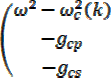


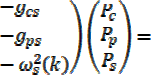

Here ωc,p are overtone/libration-dominated near-IR modes of core and interfacial water; ωs(k) is a low gap, acoustic-like far-IR/THz branch of solitonic channels. Diagonalization yields hybrid eigenfrequencies with avoided crossings; bright near-IR bands arise from Pc – Pp mixing, while the solitonic branch pulls spectral weight into far-IR. Predicted signatures: azimuthal selection by m, polarization dichroism (axial vs. circumferential), and coupling-dependent band splitting g, tunable by ionic strength, temperature, and protofilament registry.
Electronic ‘PHz’ motion = oscillation of π-electron polarization, not nuclei. For an aromatic transition of energy ΔE (UV),



That electronic excitation reshapes the potential energy surface on which nuclei move, so bond-stretch IR modes (THz) are launched via vibronic coupling. In a displaced-oscillator picture, intensities follow FranckCondon overlaps; in Raman language, vibrational activity is driven by the electronically mediated polarizability

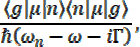


Near an electronic resonance (π → π*), α is large resonance Raman strongly couples the PHz electronic coherence to IR bond stretches (tens of THz), yielding vibronic sidebands, Stokes/anti-Stokes shifts, and ultrafast wavepackets that oscillate at the IR frequencies on the excited surface.