🍄🧠 Psilocybin Rebuilds the Synapses Depression Takes Away, and the Trip Isn't Required to Do It
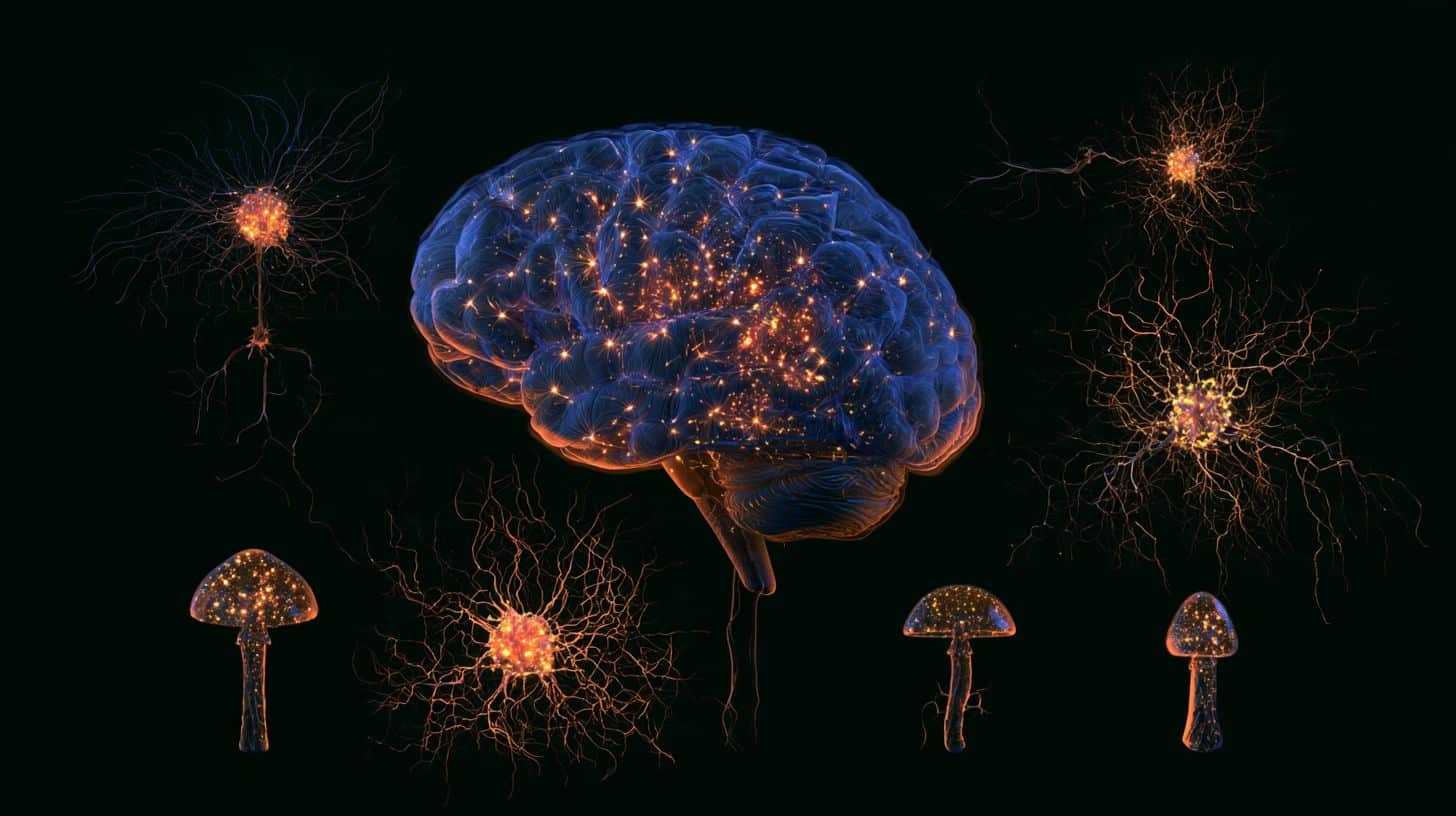
In vivo two-photon microscopy shows psilocybin rapidly driving maturation of dendritic spines in the cortex, through a pathway separate from the psychedelic hallucinations. Image credit: Neuroscience News.
⚡ The short version
A University of California, Santa Cruz (UCSC) team led by Yi Zuo watched individual synapses in living mouse brains for weeks after a single dose of psilocybin. Three things stand out:
- Fast. New dendritic spines (the tiny receiving docks on a neuron) appear within 24 hours.
- Mature. Many of those new spines develop quickly into stable, receptor-rich "mushroom" spines that last for weeks.
- Separable. The receptor that drives the rewiring is not the one that drives the hallucination-like behaviour, at least in mice.
🔬 What they actually did
The team used in vivo two-photon microscopy, which lets you image the same dendritic spines in a living animal over several weeks. Spines are where synapses physically sit, so counting and tracking them shows structural plasticity directly instead of inferring it from behaviour or gene expression.
🌱 Spines grow, then mature
Within a day of dosing there was a surge of brand-new spines. New spines are normally short, fragile "stubby" protrusions, and most of them vanish. Psilocybin pushed a high proportion of them to become large mushroom spines, which carry lots of scaffolding protein and AMPA receptors (the main fast excitatory glutamate receptor). That is the physical hardware of a connection that sticks.
🎯 The effect depends on the brain's starting state
This is the part I find most interesting. Psilocybin did not just add connections everywhere:
| Brain state | What psilocybin did |
|---|---|
| Healthy mice | Temporary rise in new spines, plus pruning of some pre-existing connections over three weeks. Net result: balance maintained. |
| Chronically stressed mice (chronic unpredictable mild stress, a standard model of depression-like synaptic atrophy) | An even bigger burst of new spines, and a halt to the ongoing loss of existing synapses. |
So the drug behaves less like a fertiliser and more like a repair system that responds to what is damaged. Zuo's group frames this as a challenge to the common "psychedelics simply increase connectivity" story.
🧬 The double dissociation (the elegant bit)
The researchers focused on the serotonin 2A receptor (5-HT2A) in Layer 5 pyramidal neurons, the main output cells of the cerebral cortex. Genetic manipulation produced a clean two-way result:
| Manipulation | Synaptic remodelling | Head-twitch response* |
|---|---|---|
| 5-HT2A restored only in Layer 5 pyramidal neurons | ✅ Robust spine formation and maturation | ❌ None |
| 5-HT2A deleted only from Layer 5 pyramidal neurons | ❌ No remodelling | ✅ Fully intact |
*The head-twitch response is the standard rodent behavioural proxy for psychedelic hallucination.
In plain terms: the receptor population in these cells is necessary and sufficient for the structural plasticity, and unnecessary for the head-twitch behaviour. The two effects run through anatomically and mechanistically distinct routes.
💊 Why it matters
- Psilocybin already holds FDA Breakthrough Therapy designation for treatment-resistant depression and major depressive disorder.
- A long-running argument is whether the subjective trip is essential for the lasting benefit. This study says the structural repair does not need the hallucinogenic pathway, in mice.
- It points at a specific cell population as the target for designing non-hallucinogenic "psychoplastogens" (compounds that trigger rapid neuroplasticity).
- The article notes a practical bottleneck in current psychedelic therapy: a dosing session can need two trained clinicians for eight continuous hours. A compound without the trip could move treatment to outpatient settings.
⚠️ Caveats worth keeping in mind
- It's a mouse study. The head-twitch response is a proxy, not a measure of subjective experience.
- The "plasticity without hallucination" result came from genetic receptor manipulation, not from giving mice a drug that does this. A real compound with the same split is still to be built and tested.
- Spine growth is a structural readout. It's a plausible mechanism for antidepressant benefit, but this study doesn't show human clinical outcomes.
- Whether the subjective experience contributes separately to therapeutic benefit in people is a different question, and this work doesn't settle it.
📚 Source and paper
- Article: Psilocybin Replaces Lost Synapses in Depressed Brains, Neuroscience News, 24 October 2026. Press source: University of California, Santa Cruz.
- Paper (open access): Baker JJ, Kogan E, Ma S, Lu J, Zuo Y. 5-HT2A receptors in layer 5 pyramidal neurons mediate the neuroplastic but not the hallucinogenic effects of psilocybin. Nature Neuroscience, 1 October 2026. DOI: 10.1038/s41593-026-02490-y
- Funding: National Institute of Mental Health and National Institute on Aging. Psilocybin supplied by the National Institute on Drug Abuse Drug Supply Program.
This post is a paraphrased summary for discussion. Read the original article and paper for full detail.