
Biology \ Molecular & Computational biology
New inhibitor restores antibiotic activity against drugresistant bacteria
by Edward Bartlett, Imperial College London
edited by Lisa Lock, reviewed by Robert Egan
Editors' notes
The GIST Add to Preferred Sources
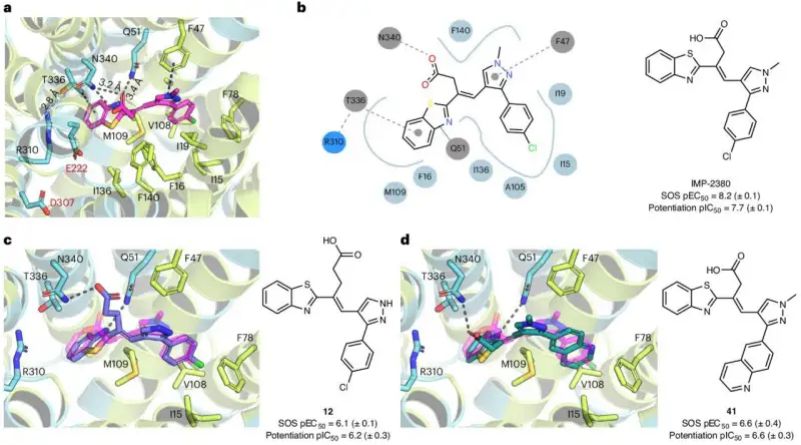
a: Cartoon representation of IMP-2380-binding pocket. b: Key interactions between NorA and IMP-2380. c,d: Overlay of docked analogs with IMP-2380–NorA structure. Credit: Nature Chemical Biology (2026). DOI:
10.1038/s41589-026-02319-6
- ··
Researchers from Imperial College London and collaborators have identified a potent small-molecule inhibitor that can restore the activity of the antibiotic ciprofloxacin against methicillin-resistant Staphylococcus aureus (MRSA).
The study, published in Nature Chemical Biology, describes IMP-2380, a selective inhibitor of NorA—an efflux pump used by S. aureus to export antibiotics from bacterial cells. The work was led by researchers including Professor Ed Tate and Professor Andrew Edwards, with Dr. Janine Gray and Dr. Elizabeth Ledger as co-first authors.
Blocking a bacterial defense mechanism
Antibiotic efflux pumps help bacteria survive treatment by lowering the concentration of antibiotics inside the cell. Although these pumps are recognized as promising targets for antibiotic adjuvants, the development of potent and selective inhibitors has been challenging.
The team began with a high-throughput screen designed to identify compounds that suppress the bacterial SOS response—a DNA damage response that helps bacteria survive antibiotic treatment and can contribute to the emergence of resistance.
Screening 33,000 compounds identified a chemical series that inhibited the ciprofloxacin-induced SOS response without killing bacteria directly.
Further optimization produced IMP-2380, which showed nanomolar potency and increased the activity of ciprofloxacin against MRSA and other S. aureus strains. The compound did not show intrinsic antibacterial activity in the absence of ciprofloxacin, supporting its potential use as an antibiotic adjuvant rather than as a stand-alone antibiotic.
Revealing how IMP-2380 works
Genetic experiments identified NorA as the target of the compound series. Bacteria that overexpressed norA were less sensitive to the combination, while bacteria lacking the gene no longer responded to IMP-2380. An ethidium bromide efflux assay showed that IMP-2380 inhibited NorA-mediated transport with an IC₅₀ of 19 nM—more than 400 times more potent than the commonly used reference inhibitor reserpine.
The researchers then used cryo-electron microscopy to determine the structure of NorA bound to IMP-2380 at 2.52 Å resolution. The structure shows the inhibitor deep within the transporter's central cavity, locking NorA in an outward-open conformation.
This prevents the pump from switching between the conformations required to bind and export antibiotic molecules.
This structure provides a framework for designing further inhibitors and reveals a previously unobserved small-molecule binding site in NorA. Importantly, the inhibitor binds from the extracellular side of the transporter, meaning that it does not need to cross the bacterial membrane to reach its target.
Reducing resistance as well as restoring treatment
By blocking NorA, IMP-2380 increased the intracellular accumulation of ciprofloxacin and enhanced bacterial killing. The compound also reduced ciprofloxacin-induced SOS activation and prevented the emergence of ciprofloxacin-resistant populations in laboratory experiments.
In a mouse model of MRSA infection, IMP-2380 alone or ciprofloxacin alone did not significantly reduce bacterial burden. However, the combination produced a significant 100-fold reduction in bacterial numbers, with three of five animals having bacterial levels below the assay's limit of detection.
The findings establish NorA inhibition as a potential strategy for antibiotic adjuvant therapy and provide a chemical probe for investigating the relationship between drug efflux, bacterial stress responses and resistance evolution. Further work will be needed to assess the compound's safety, pharmacology and therapeutic potential before any clinical application can be considered.
Publication details
Janine L. Gray et al., Small-molecule inhibitors block NorA efflux by conformational trapping, Nature Chemical Biology (2026). DOI: 10.1038/s41589-026-02319-6
Journal information: Nature Chemical Biology
Key concepts
Who's behind this story?

BA art history, MA material culture. Former museum editor, paramedic, and transplant coordinator. Editing for Science X since 2021. Full profile →

Bachelor's in mathematical biology, Master's in creative writing. Well-traveled with unique perspectives on science and language. Full profile →
Provided by Imperial College London
+ Explore further
New molecule found to suppress bacterial antibiotic resistance evolution